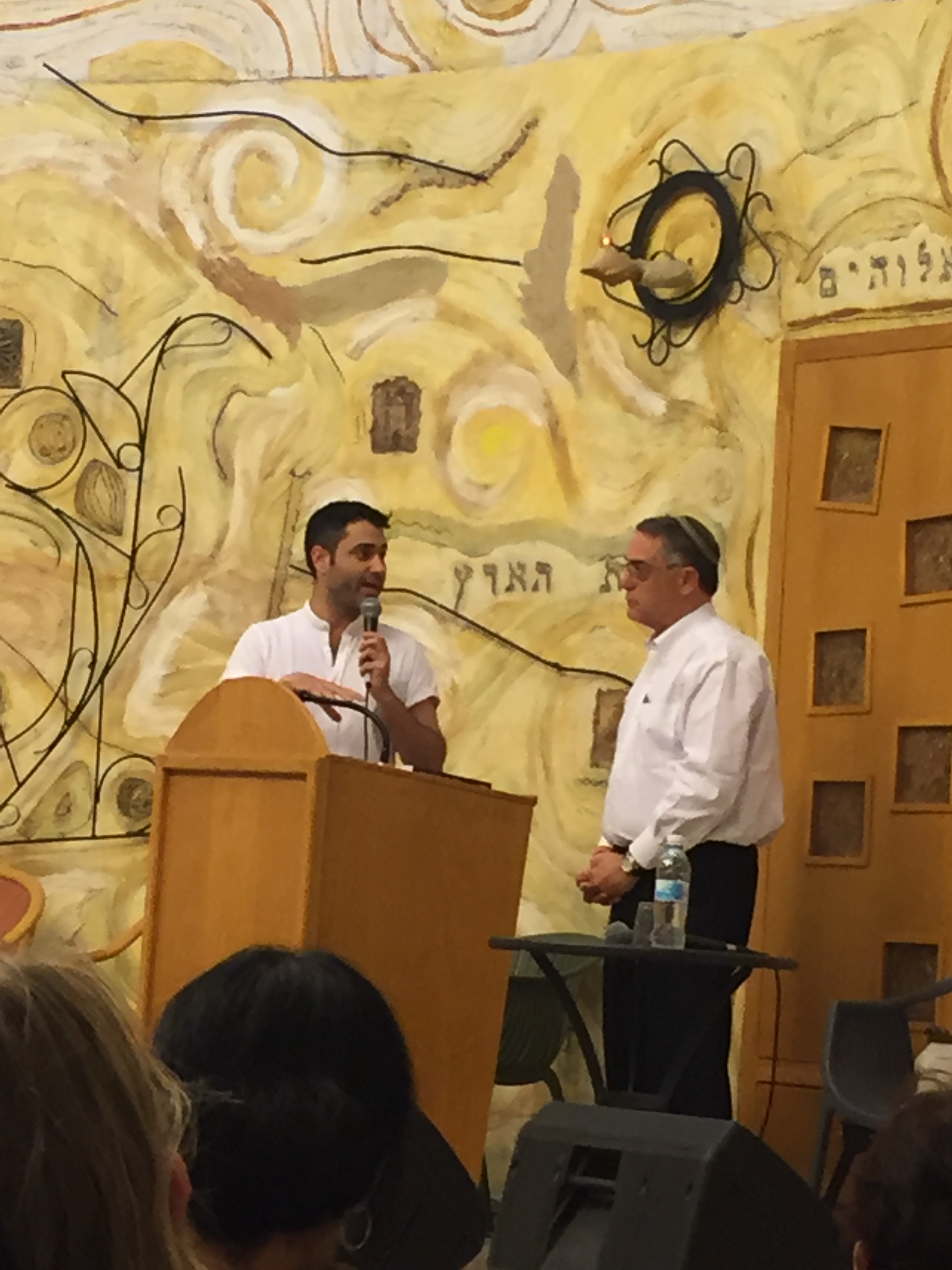
Time Lapse – Thoughts for 2024

It’s been awhile since I used this platform. Ten years ago In 2014 I took a leap and joined a group of Israeli women on a trip to India.

I wanted to share my emotions and impressions. I experience meditation and Yoga in a new environment. Since then I would mostly write about art and travel. Art is a subject that feeds my soul. Through travel I get to explore and discover new traditions, new customs and a lot more.

Today we celebrate the new year for the trees, Tu Bishvat. It’s a sign of renewal and growth. Today we also mark 111 since October 7th. 111 days that Israeli hostages are in the hands of terrorists. I wear a dogtag: Bring them home, we put blue ribbons on the trees to remind the world that we do not forget those taken hostage. Our soldiers are in Gaza fighting the terrorists, bombing armor stashed in tunnels.

Since October 7th when Israel was attacked by Chamas terrorists who did not discriminate between civilians to soldiers, between children and adults, between women and men, I have been itching to go.

It was the first time since moving to the US that I felt the need to be home. Although I have build  a beautiful home with my husband Geoffrey and we raised three kids and have grandchildren, somehow the country I was born at- Israel will always be home.

I was anxious and worried about the fate of the country. I knew that I needed to go and do something . I felt that as an Israeli citizen I need to join my brothers and sisters in defending our land in any way possible.

I flew on November 7 and landed at 6:30 am. Driving to my mom’s apartment I was struck at the emptiness in the airport, only El Al plains were flying , on the way to get my passport stamped, rows of photos of the hostages lined the path. The traffic to Tel Aviv was light, the Israeli flags adorned every street corner and billboard. On Independence Day it is a custom to hang the flag but this time it was for solidarity. Everyone is united with one goal in mind. Together we will win.

On Hanukah there is a song, we came to erase the darkness , in our hands we have light and fire, everyone is a little light and together we are strong light. 

The first place I went was the “Chamal (war room) Diskiot (Dogtag) “, volunteers ,mostly women sat in rows and packed dog tags that said, bring them home now. The money raised form selling them will go to the families of the hostages. Around 240 hostages were taken by Hamas, the number changes as sometimes a person who was considered hostage is found dead. Since the beginning of the war 87 Israelis were released. Hamas still has 137 hostages , among them 11 foreigners, 2 babies under 18, 114 between the ages of 19-74 and 10 above 75 . There are 20 women and 117 men in total.

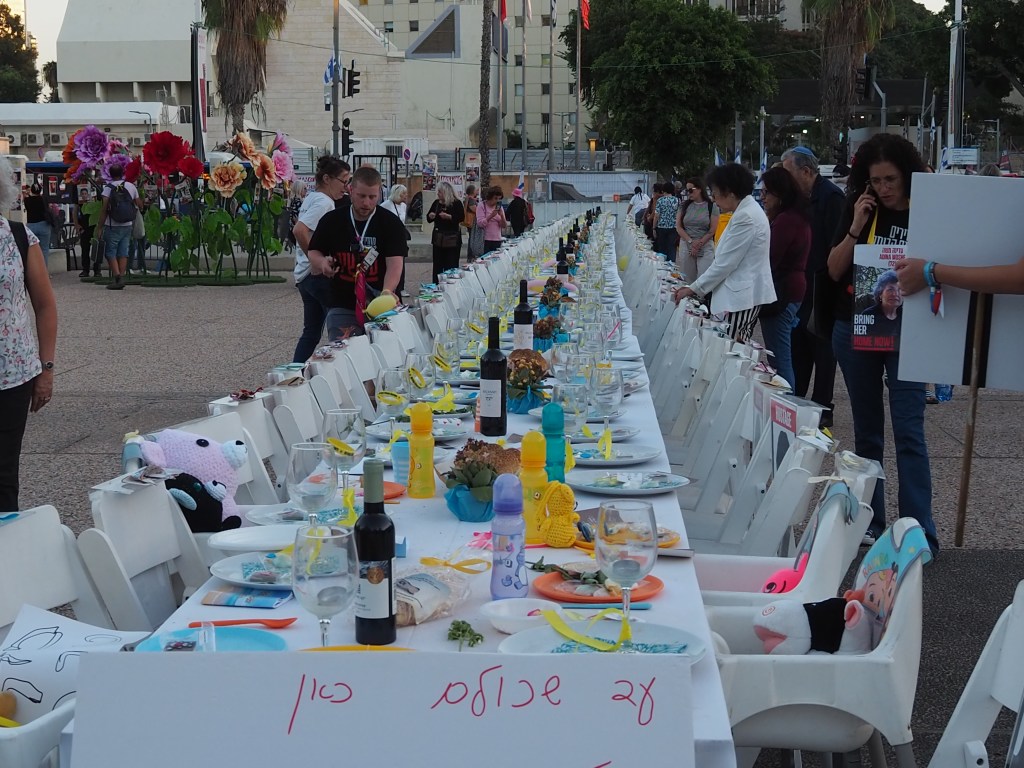
In the evening I went to sit with the hostage families. The square in the from of the Tel Aviv museum is now called Hostages square. Different art installations were made to raise awareness and keep the hostages on the front page. A shabbat table was constructed with 243 seats , baby seats among them. Some of the hostage families sleep in tents. 
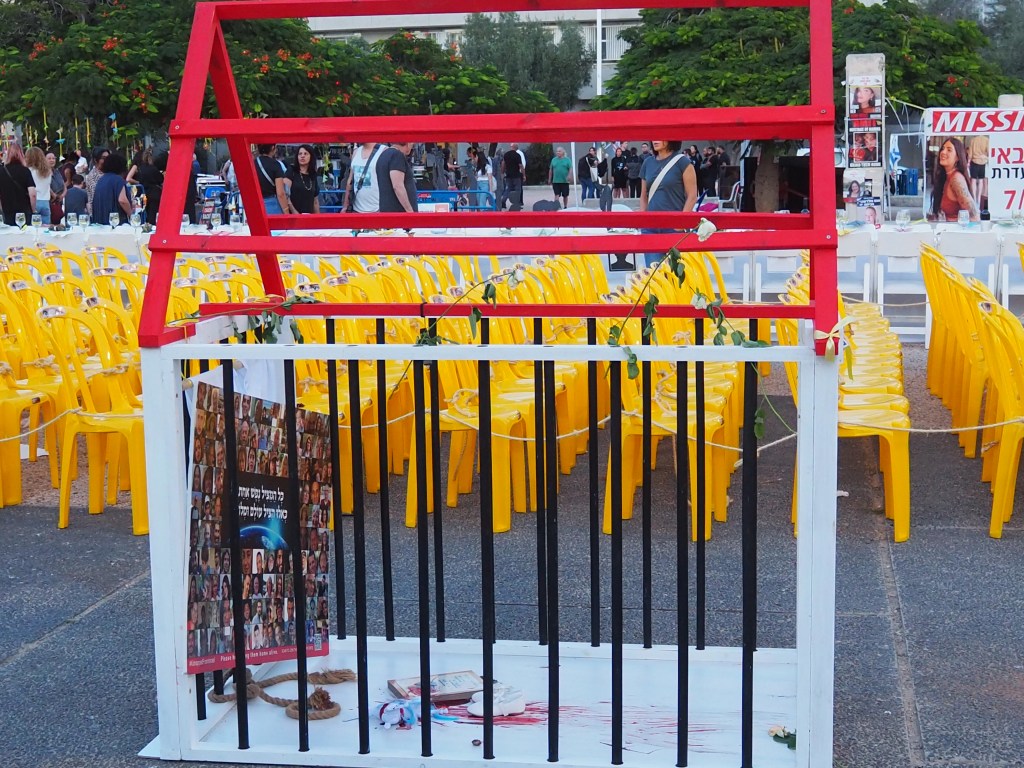
The square is facing the main army headquarters where the prime minister security council meet.

The next day I was picked up by Ofer who was one of the organizers of the demonstrations that took place almost at the same place as the hostage families seats.  All the energy and desire to change is now working towards helping the 250,000 displaced families from the south who either lost their home or don’t have a safe room or safe place to run in case of missile attack.

We drove to Givaat Haviva, it is a civil society organization that strive to create a model society I Israel, emphasizing the importance of a jewish and Arab shared society. They run education programs and house both Israeli and Arab children. Their program stopped and they house refugees form Ashkelon. They created kindergarten for the kids and signed the order kids to school nearby. These people left their home with nothing much. They put each family in a small room with bunk beds with no kitchen and no washing machine. They got donations of machines and cloths. A kindergarten was created for the kids so the parents can look  a job nearby.
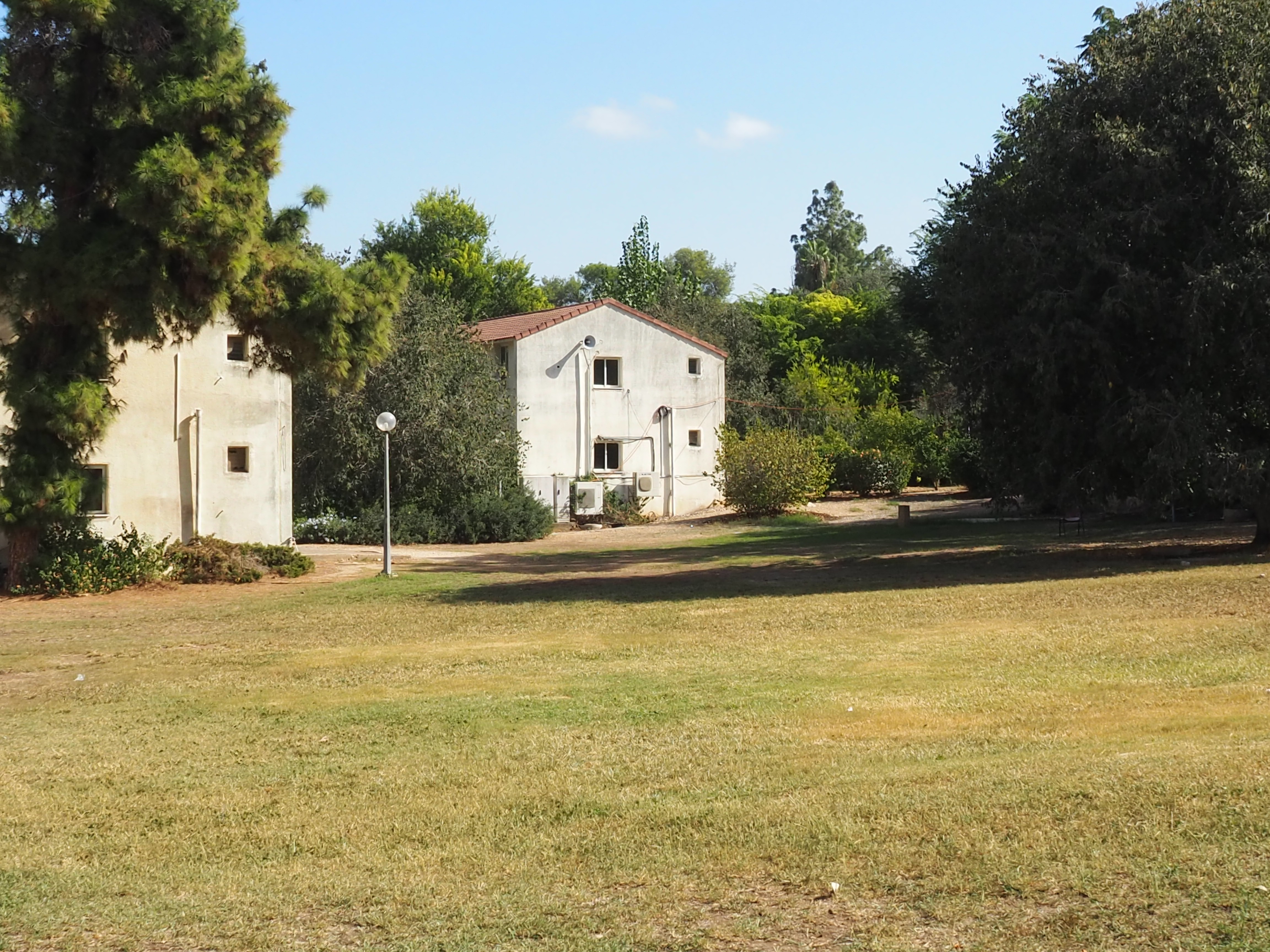
Next we drove to Binyamina to visit another Chamal, where volunteers are calling families who had to leave their homes, they did not want to go to a hotel so they try to find an alternative place for them, asking questions like do you have a dog? how many Children?  

On the way to Tel Aviv I stopped at Chamal brothers in arm, at the beginning of the war they took over a hangar that used to be for exhibitions and filled it with cloths, diapers, toys, army supply, by the time i arrived, a month after the war started they also occupied a floor that a high tech company donated and there, they divided the rooms by needs, one room was to deal with the hostage families, so if someone wanted AirPods , someone was sent to buy and deliver it. Another room was for ordering army supplies to the emergency preparedness squad, in another room they worked with the tax authorities in the airport to release the equipment that arrives for the army . 

It was Thursday evening, I heard of a woman who is cooking kosher food for the refugees in one of the hotels and also to Gaza for the soldiers.

I grabbed my friend Aya and we drove to the south of Tel Aviv to help her cook the meals. Someone was going to pick it up at 2 am to drive it to Gaza.

Friday morning I went to see an installation at another Tel Aviv institution Habima square where the philharmonic plays and the national theatre performs are closed , all the actors/ singers are traveling to the refugees and army bases to try to uplift everyone’s spirits. Restaurants are closed , No one has any desire to go out. This installations of empty beds has 241 beds.
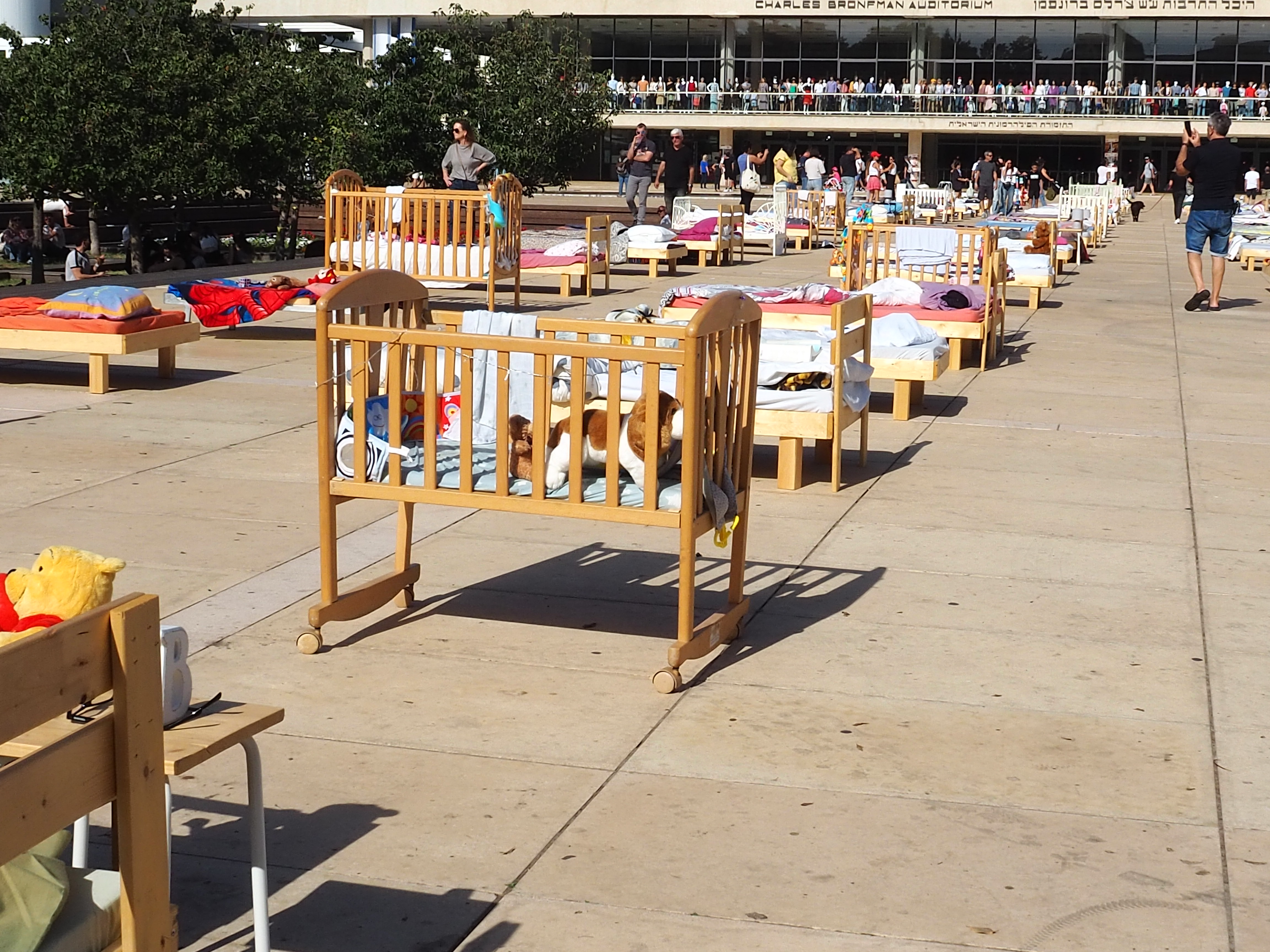
Kikar Habima

The “empty beds” art installation consists of 241 beds, equivalent to the number of kidnapped men, women, children, and infants being held in captivity by hamas-isis in gaza. The beds portray the unbelievable size, dimension and vastness of our disaster. And the magnitude of our call to action that is – To bring every last one home now!

The creator and visionary behind the installation is the artist and sculptor Eran Webber, who partnered with strategist Vered Huri. Together, they launched the installation for the families of kibbutz nir oz and all the families of the abducted men and women. The installation amplifies the cries of the abducted and their families and is intended to keep the issue on the global agenda.  It’s called, empty beds, a bed is home, its the place where my day and your day ends but also starts. But now we don’t have day and no night.The artist Eran Weber create it with Vered Churi.

I continued to the hostage square to take part in Kabbalah Shabbat where the chief army cantor performed and some hostage families talked .In the middle there was a siren and we all walked into the shelter and stayed there for 10 minutes. Near by we heard a boom and later found out that a piece of a rocket fell on a car, the person inside got hurt as she did not get out fast enough. 

Life goes on, Kabalat Shabat continued.

On Sunday I drove to Jerusalem to visit the Chamal yerushalmi. First stop was at the culture center which in regular day has the Nisan Nativ theatre school but now they converted the space to a makeshift clothing store. The evacuees would come and take whatever they need. Shoes, sweaters etc . We have to remember that they left their house empty handed with one set of cloths.

In the performance hall the hanger with different items are housed  families sen da list of what they need.

The Chamal head quarters are housed in the Bezalel school architecture  building.

In the evening I joined a group of JDC board members who flew for 48 hours to see the work on the ground.

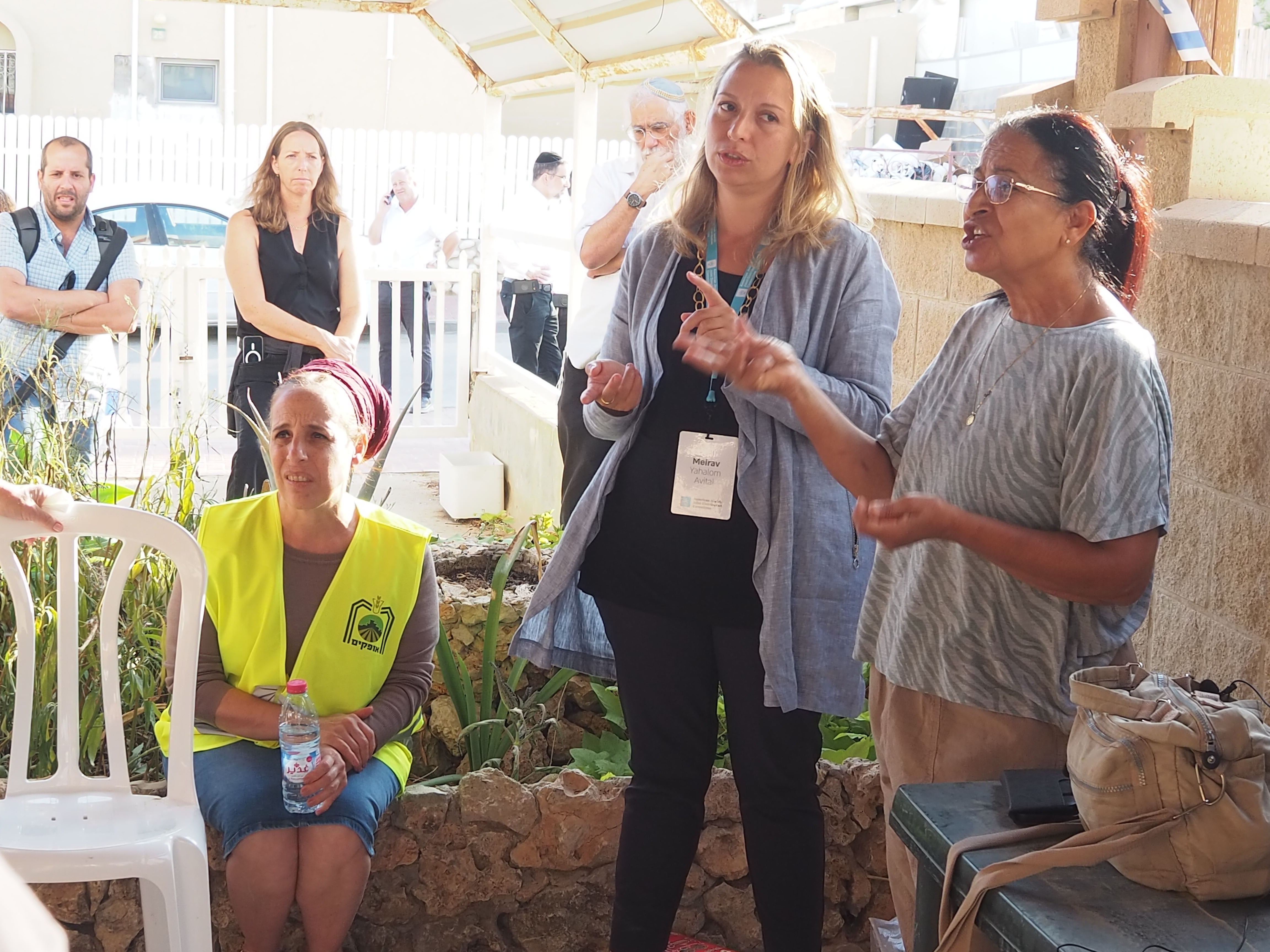
The first evening we heard form two hostage families, Romy Leshem Gonen ’s mother Merav told us that her Arabic gardener helped locate romy’s cell phone and sadly they realized that she was kidnappped, she is still in Gaza. During Hanukah I read in the Israeli papers that her grandma is pleading with Galant to bring her back. How can she survive in captivity for so long (64 days). They live in Kefar Veradim which is in the north, Romy was kidnapped form the festival.Next we heard from Rachel Baruch whose husband Ariel was kidnapped form the festival as well. He called her at 6:30am and said he will come home early because of rockets , he was in Miflasim 2 km from sderot. When she called him later , a person answered the phone in Arabic and said allla akbar. She understood that he was taken.She has a five year old at home who is asking where is dad?Her brother in law said it is like living in the dark.

They believe that all will be back. 

We heard form Ofrat Berman from the hostage forum.They have a support system of volunteers who provide phycological help and anything they need.

The company: Checkpoint gave a building to the hostage forum and they give economic support as well. The HMO’s have a file on each hostage with their medical information so they can be prepared when they will be released and can access each person’s condition before and after.

Next we heard form Miri Eisen who is a retired colonel of the Israel defense forces with background in military intelligence. She said that the chamas charter equals the prisoners of Zion. The number of hostages is unprecedented and there is nothing to compare. There are hundred of people in dozens locations. There are more then one terror group who is holding them.  . We have not seen this kind of atrocities. Her analysis is alarming. We have. Long road to destroy Hamas and Israel has to do it in a systematic way.War is a terrible thing.

JDC focus on mid term and long term intervention. They work in partnership with the municipalities, goverment ministries and UJA .They coordinate with the hotels to which the evacuees were send and create different programs.

On Monday morning we drove to the Dead Sea.

Each community is housed in a different hotel. There are 2500 kids age 0-18. 

We first visited a spa that was converted into a center for disabled kids age 4-8. In place of the products we see children books and toys.

We then met Tomer who created a school where a solarium for glamping was there . The school was build in three days with support from the education ministry. The principal is form Kibbutz Beeri. It’s a place where the kids can be to get support by talking to each other and getting hugs. It is build across the road from the hotel where they were evacuated to . At the beginning they were reluctant to leave the hotel but slowly they came.

The next hotel were people form Sederot. Some of then are in the hotel and some are in other places like Netanyahu and Tel Aviv. They created a center where anyone can get help regarding their rights.

The next hotel was the David hotel where Kibuutz Beeri evacuees stay. The kibbutz had 1000 house holds , 30% were killed or abducted and their homes were ruined. They cannot go back to the kibbutz as it is war zone. Some were aloud to check on their home and needed an army escort to get in.

JDC build a kindergarten in place of the dining hall. Each kid got a back pack with his /her name.

We met with Izik Who manages  the psychological department for the area that was hit. He is from kibbutz in Zurim, this kibbutz was evacuated to Eilat. On October 7 he went for a walk, his knee heart so he went back to the kibbutz and at the entrance he heard the red alert. He lay down behind the garage for fifteen minutes and then called his wife who was in a different home and she told him to go into the main office of the head of Eshkol region. While he was in the safe room he heard what was happening in the municipality. He lost hundred of patients and friends. His son told him that they kidnapped a neighbor. His family was saved because they live in a smart home and saw the terrorists on the camera. The terrorist got scared and ran away. His family was saved but no one came to help for a long time. The first people who came to help were the Joint. They went to all the hotels and gave immediate professional help.They try to teach the parents how to deal with their kids. One of the tools they use is the HUBUKI doll, it is  a way for the family to connect and help their kids express their pain. The kids hug the doll and pretend that they take care of the doll. When they are in a safe environment they can relax.The parents learn how to communicate to their child through the doll.

The JDC also mobilized the youth movements in helping to organize the younger kids.

On Tuesday morning we went down to Kibutz Brosh where there is an elderly day center which was reopened . People form near by kibutz kedar and Kibutz Asher which are 17 KM from the border come and have few hours of activities. 

Eshel also works with the caregivers. Some caregivers were kidnapped and some left the country. Eshel developed webinars for to help with care for the elderly.

We had lunch with soldiers form the artillery division. They shoot missles into Gaza.

We then drove to Ofakim. The terrorist drove on the Main Street and shot at anyone who was walking on the road to synagogue. The police was trying to fight , many policemen died. In front of a house where someone died there is a memorial candle.

We met a woman whose daughter in law came to visit her with her 6 kids , one of them an infant of 6 months. 

She climbed to the second floor and help the kids go on the roof through a window and they were saved .

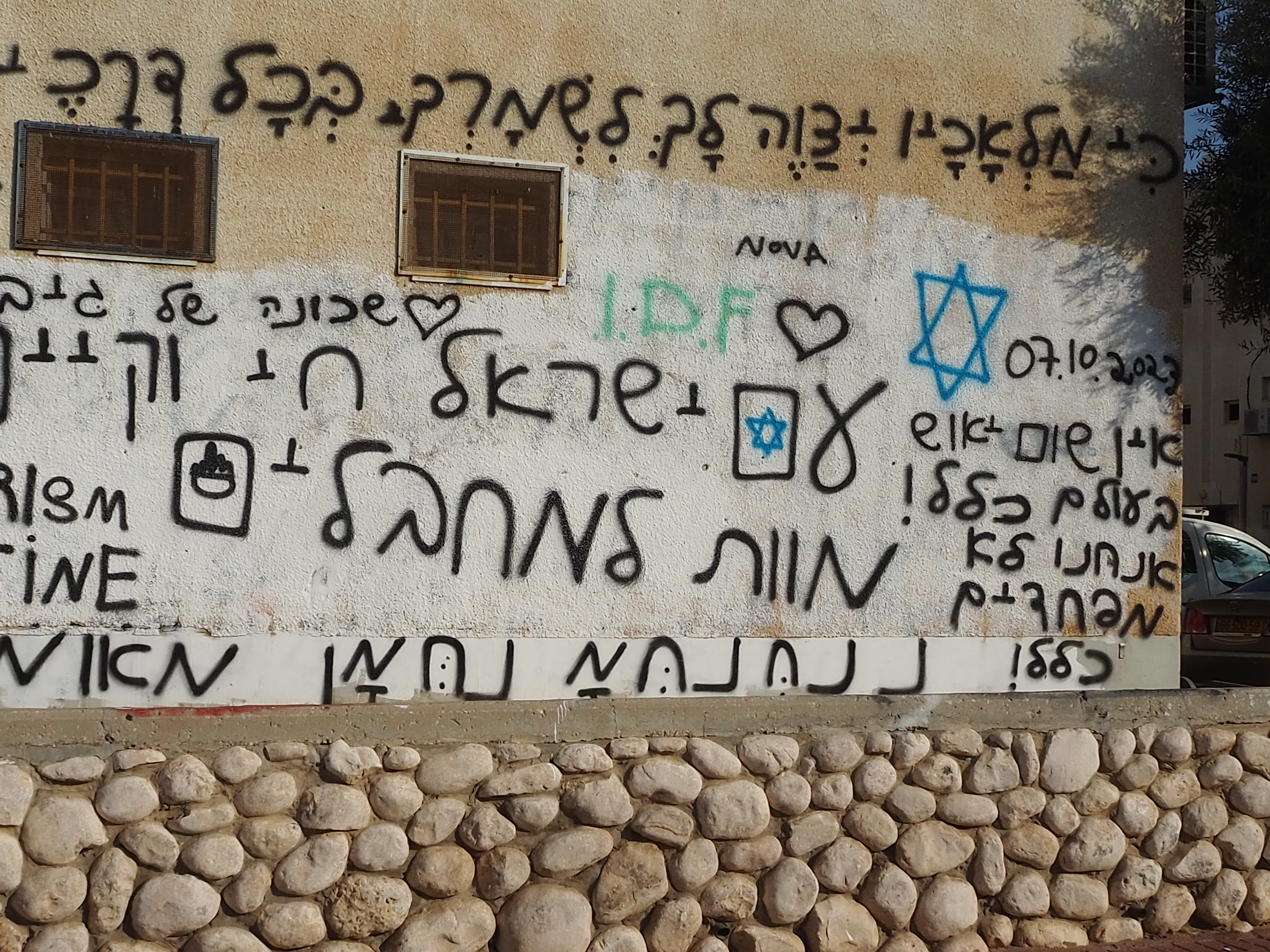
The terrorists through a grenade into the house which made it inhabited but did not get to the kids.

We then visited a new center that was created for rthe community where they can spend time talking about their situation. An artist created a wall where the citizens can express their fear and horror.

Many companies and individuals volunteer to pick vegetables and fruits as the Palestinian workers are not aloud to enter and Thai workers , some left the country. Soon it will be time to plant for the next season.

I talked to an Israeli friend yesterday, although it has been months since I was there are still have hostages in Gaza, missiles are shot into the country in the South and the North. Some restaurants opened but overall the joyous life that we are used to see in Tel Aviv and other cities is not there.
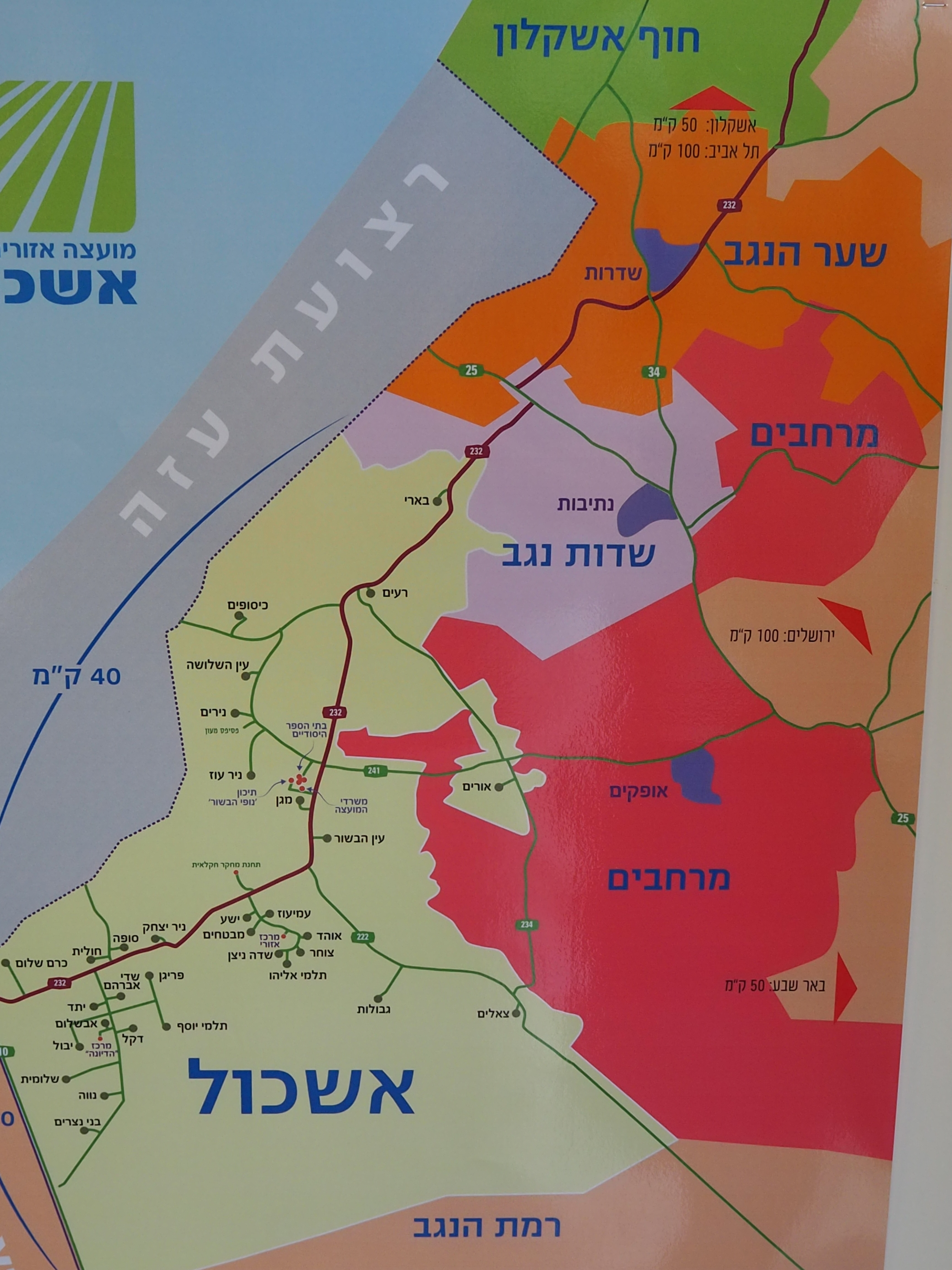
Map of Gaza border(Gray), the light green area are where the attacks took place.

Art, Bananas and a lot more..

In the last two months my travels took me to Herzliya and Miami.

There is no connection between the two cities; one is in Israel and the other in the U.S. But maybe Art is what connects us all, not  defined by borders or boundaries.

I saw lots of art and actually there was one artist; Alison Zuckerman, who popped up in both places. The Herzliya Museum is a gem of a place which can be found fifteen minutes from Tel Aviv. Aya Lurie who runs the museum manages to put up shows that highlight incredible artists and tell a story. In the current exhibit it’s about portraits. She called it “portrait time” and indeed each of the artists in the show manage to tell their personal story. Each of the stories invites us to enter the artist’s mind, hence finite time.

When one walks into the museum there is a wall painting in black charcoal. It is like walking into a cave and reading a story through pictures. It is a work by Maria Saleh Mahameed. She draws her life in the past year where she has hovered between life and death. Helping a child who needed a blood transfusion and healing herself from an accident. The artist in the next gallery is Natalia Zourabova who tells the story of her daughter, born to a house of Russian immigrants. The images describe her adaptation to her new country. We continue our tour and enter a room full of colors. It is the work of an American artist, Alison Zuckerman who takes classic images and adapts them to the new times. She is creating a re-mix of contemporary art with pop culture. We continue the exploration and come to a dark room. A video is projecting images of a boy visiting different art institutions. It started when he fell asleep looking at art at the Israel Museum. This work stands as a memorial to Ari (the artist Iris’s son) who died in a road accident at the age of 17, a year before the show. It is a true representation of the title: “Portrait Time.”

Images stay in our mind and we use them to tell a story and to remind us of those we love.

Tel Aviv is full of galleries, but you can find interesting art just by walking around. Graffiti is all over especially in the Florentine area. Those artists tell their story and convey their ideas for all to see

There is a lot more art to see in Israel, but it was time to come back home and fly South to Art Basel Miami. I have not been to the fair for a few years and I was looking forward to seeing what would I find? I decided to spend two days and see the main fair and maybe some of the smaller fairs and hopefully check out Design Miami. As we landed before the main fair opened, we checked what’s new in the world of design. Some interesting swing chairs in the shape of a ball piked my interest although I am not sure how comfortable they are. Lots of pottery and modern furniture. We took a walk on the beach and got to see the fair Untitled. It was a bit disappointing… not much new, lots of colorful paintings and again pottery. At night we visited the main fair’s special session, The Meridians where they highlighted different artists.

The main fair opened on Wednesday.  It was nice to see some familiar works by artists I like and discover some new ones. Again, lots of pottery. It seems that pottery is the new medium. I will let the images below do the “talking”.

Mera and Don Rubell has been collecting art since the early 80’s. see

It is a “must” to visit their collection as they focus each year on a different theme and artist, but this year, recognizing that their museum was too small to show their enormous treasures, they opened their new space. They showed around 150 works out of the thousands works they collect. They picked one or two pieces of the same artist and tried to work in a chronological order. It was a real celebration. Among their collection they had two Kusama rooms…. no need to wait on long lines to enter, and Keith Herring, Murakami, Jeff Koons and lots more.

Back to New York I took a friend to see the re-opened MOMA. It’s big and you will need a whole day and maybe more to real enjoy the rooms. The curators did a fantastic job showing the art and the influence the artist of a particular piece had on a younger artist. There is a lot to say so I plan to  devote another blog on that experience.

This final image says it all. Art makes me think. Looking at art is like trying to figure out what was the artist thinking, what was he or she trying to tell us? When I read a book I create an image in my mind, it is like drawing a picture. Cattelain- the “comedian” made us laugh with his banana duct tape to the wall.  see

There is an Instagram account that makes fun of his work, he definitely makes us think and even be creative, who knows…. maybe that is what the artist intended. At the end of the day when we go to sleep all that we remember are the good times we had today.

871dfc15-4f31-4338-bc89-5038506f1ddf.jpeg

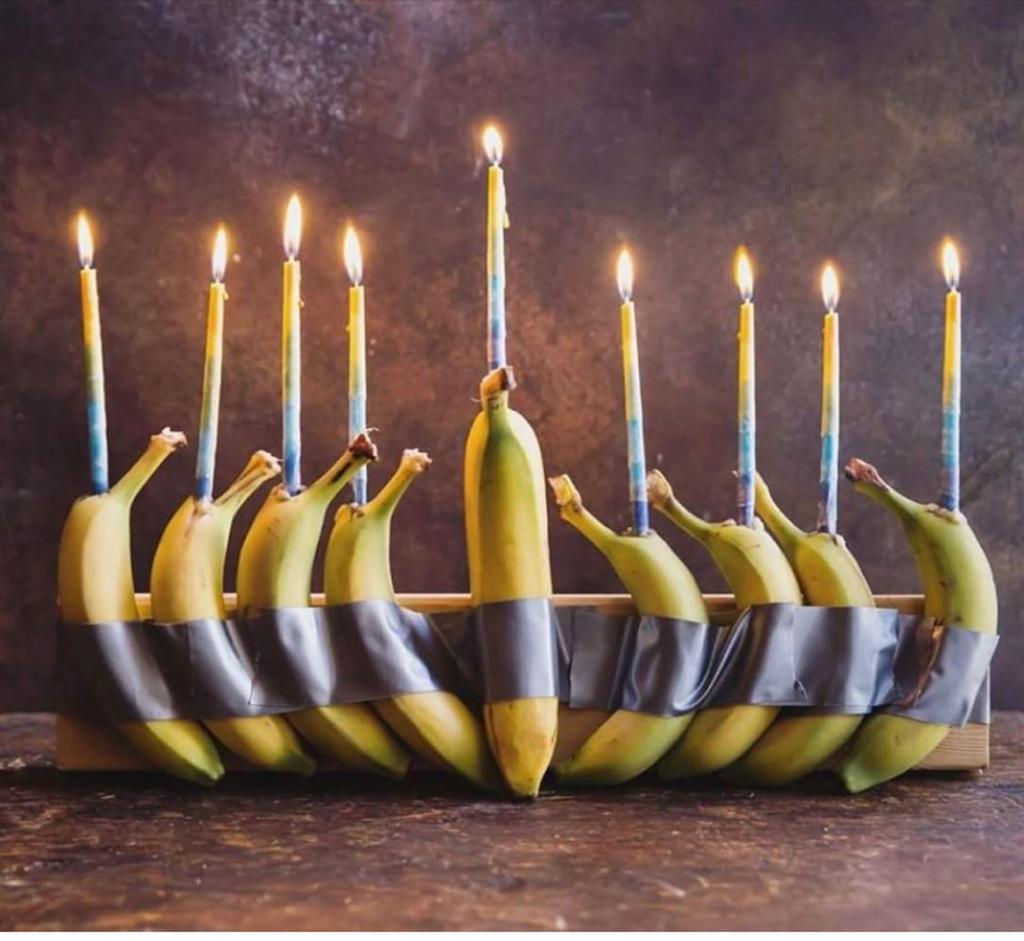
As this blog will be published during Hanukah, here is a menorah “in the style of” Maurizio Cattelan’s “banana art”.

Hanukah Banana

The JOINT- JDC- Repair the world

Every two to three months I fly to Tel Aviv and visit my mom. I got used to the hours being cooped on a plane and jet leg does not bother me much. My last trip to Israel was more than a visit to my mom. I joined thirty-three JDC board members on a study trip.

I was introduced to the Joint a few years ago through their social research arm-The Taub center. In past years I have travelled to Cuba, Poland and Russia and I
Learned of the global work this organization does.
The Joint helps Jews around the world. Most of the time we find a JDC person bringing food to an elderly person and supporting a person in poor health. They also work to renew and enable Jewish identity.

Joint-Israel has a unique mission. In Israel, the Joint helped new immigrants settle in their new country-ISRAEL.

Joint-Israel helps the most vulnerable segments of the population by creating programs that help them rise from a low economic level and by that elevate this population up from poverty.

As the country is 77 years old the population grows and therefore is faced with multiple problems.

We wanted to learn what are the areas that needs that magic start-up nation touch from a social perspective. The best way to understand is by visiting diverse populations, in our case an Orthodox community, a Bedouin village and an elderly center.

We visited the city of ELAD. It is an Orthodox City. Many of the men study in Yeshiva or Kollel. The city does not have any industrial outlet and most of these men who work, work as teachers. They get subsidies from the government. As the population expands there is a need for other sources of income. We met with Deborah who hosted us at her meticulously clean home. She was proud of her children who excel at their studies. Her husband runs a yeshiva and she works at the municipality in charge of early childhood education. We saw the library and met the mayor. The mayor was proud of his many achievements such as taking teens at risk and through working in the garden helped them with their problems. Not everyone is meant to study. The Joint initiated programs that teaches other skills.

Our next stop was the Bedouin city of Kerem Shalem. We visited an early childhood center. The children age 2-5 spend the day in the center and get a hot lunch there as well. The Bedouin society believes that a woman’s place is at home and that children should stay at home as well. By creating the center, it allows the mothers some freedom to pursue skills and be able to get out of the home. On a different trip I took we visited a women’s initiative that made items with the special Bedouin embroidery.
We continued to visit an unauthorized town, the tents are replaced by temporary huts. There is no electricity or water supplied by the government.
The Bedouin population is part of Israel, they get welfare support for the government.

On the third day we traveled to Bat Yam, a city just 15 minutes south of Tel Aviv. The Old Age Center was full of people busy with activities like dancing, making crafts, and lectures. The number of older adults 65+ in Israel will rise by 80%, they will be 30% out of the population. There are multiple problems and the Joint has many programs that help caregivers and encourage independent living. There is a benefit to the society whose elder members are able to function independently as they deal with a decline in their functionality. Eshel is building rehabilitation centers with an emphasis on integrative care.

All of these programs will not be effective without the government support. We met Iris from the Ministry of Social Affairs and Yariv from the Ministry of Agriculture who praised the collaboration with the Joint. The government relies on the Joint for the development and roll-out of successful programs. Here again we were reminded of the ingenuity and the vast knowledge base the Joint has in solving social problems.

We travelled to Rishon Lezion and visited the Innovation Design School which is part of The College of Management and Academic Studies. We learned about the challenges facing disabled people to be included in the society. Ultimately, it costs less to keep a disabled person at home than in an institution.

OLYMPUS DIGITAL CAMERA

Our last stop was at “Hackaveret “ (means beehive), a hub where ideas for social change are developed.

In Hebrew we say: “Hayom Katzer V’hamelacha Meruba”. The day is short and there is a lot to do.
Elka the fourth arm of The Joint in Israel deals with the systemic challenges by engaging companies and individuals and by bringing technology into social services and working on digital literacy.

The vision Joint-Israel has of strengthening the Israeli society’s capacity to care for it‘s people and promote resilience is rooted in its original mandate but as time progresses so do the challenges and needs change. To make an IMPACT we need to look at the problem as it touches each population and sometimes one finds the same problem but it is a different target audience. There is a need to understand the individual needs. The Joint has the ability to bring to the table different players to address the problem. In the past the Joint would hand over the programs to the government after a short time but now it seems that to make a lasting impact we need to hold on to the programs and measure the outcomes a bit longer.

I grew up in Israel and left when I was 24 years old. Tel Aviv, the city in which I was born changed dramatically as did the rest of the country. I was not aware of all that The Joint contributed to the health of the society. I think it is imperative to acknowledge the enormity of the task the Joint is facing in the 21 first century to secure a healthy Israeli society.


ELAD: https://en.wikipedia.org/wiki/El%27ad

BEDUIN: https://www.myjewishlearning.com/article/the-bedouin-in-israel/

Traveling to see Art from West to East

It seems that February was a month of traveling. What better way to get some vitamin D then to go where the sun is shining.  You’d think that going to LA would fit the bill, but to my surprise it was cold and rainy. It was the art that brightened my visit. Frieze, is an art fair that originated in London then expanded to New York a few years ago and in 2019 opened in LA. Logical, becasue many NY galleries have already opened a satellite gallery in Los Angeles. The Art Newspaper called the arrival of Frieze Los Angeles a turning point in the art world’s tense relationship with the entertainment industry. Afterall, we all like to read the gossip about which actor/actress was spotted at the Miami Art Basel or at the auction house. The art world is changing but at the heart of it is the artist so lets see what caught my eye.

I arrived few days before the fair opened and visited The Marciano Foundation Art Collection which is housed in an old Masonic Temple. There was an interesting installation of works by Ai Wei Wei called “life Cycle”. In the middle of the room there was a boat made of bamboo with figures of people and animals. It is Ai’s response to the global refugee crisis. All around, suspended from the wall and ceiling, were figures crafted from bamboo and silk porraying mythical creatures from the mountains and the sea. When you walk down, you feel like you are at the bottom of the world, or maybe in a womb passing through the cycle of life. A quote from Kevin Gilbert: “Unity” 1994 was displayed: ” I’m the tree you are me with the land and the sea we are one life not three in the essence of life we are one”.


The morning Frieze opened, the sky opened as well. We were given pink umbrellas and walked from the parking lot on Paramount Pictures studios. We spotted Jodi Foster and Brad Pitt … but aren’t we here for the art? Well, there was a lot of it.  I will share some of the images later. It seems that the fair took over the whole studio and when we walked out of the main building there were pop up restaurant like Roberta from Brooklyn. There was also art hanging, literally from the building (yes, like hanging laundry..)


I left LA and after a short stop in NY flew to visit my Mom in Israel. The Israel Museum had a show called: Maimonides: A legacy in Script. One may ask, isn’t this supposed to be in a library? We walked into a dark room filled with manuscripts of the Mishnah, The Guide for the Perplexed and more. All had incredible illustrations and beautiful calligraphy. The first manuscript: “Commentary on the Mishnah is believed to be written by Maimonides himself. He labored over his commentary on the Mishnah mostly during his travels till he got to Egypt but continued updating and proofreading. There was magic in the air. A hard to describe feeling of awe.

The writing was in Hebrew which I could read and date illuminations added to the text.


We continued to see what else the museum is presenting. There was a show of Russian Avant-Garde and Beyond titled Victory Over the Sun.  Art that was created during the 20th century. With a focus on the emergence of the art movements that accompanied the historical and political upheavals in the country. The linear drawings are strong and are reminicent of art in other parts of the world at the same time.


The last exhibit we visited was called Manifesto by the artist Julian Rosenfeldt.

The artist revisited dozens of 20th century manifestos examining their relevance and power today. The artist Cate Balanchett performs the monologues as different characters.

There are like 20 videos, each touching on a different art movement which as a whole gives us a picture of the world we are living in today. It’s a powerful representation of the 20th century.

I felt as though I was in school. The images starting from the writing of Maimonides to the Manifesto left me with questions and a desire to explore and learn.

I am back in New York. The ground is covered with snow but it seems that art shows are sprouting everywhere. The Armory show starts on March 7 and so is Nada and much more to come.  More material for my next post.


New Year-the journey continues

They say times flies. This idiom was first recorded about 1800 but Shakespeare used a similar phrase, “the swiftest hours, as they flew,” as did Alexander Pope, “swift fly the years.” When I realized that it’s been more than a year since my last post I ask myself, where did the time go? What have I been doing all the last year?

Well, it’s time to change that.

It’s February 2019, I will try to post more frequently. My goal is to write about the art I see and that talks to me, at least once a month.

A few weeks ago I made a list and headed down to Chelsea. I wanted to see the new works by Lynette Yiadom-Boake, an artist I discovered a few years ago at the art fair in Chicago. She was born in London, won a few prizes and is included in numerous institutional collections. The images in her paintings are pure imagination; she studies old paintings and lets her brush tell the story.

This show is called “In Lieu Of A Louder Love”. There is a poem which she wrote that might shed light on the images.

In Lieu Of A Louder Love
In the Shade of Hooded Cove,
In Debt to the Dead Oak.
In Range of a Twelve Gauge,
On Embers over Smoke.
 At Pains to Hold the Wanton,
At Home to all who Knock.
At Prayer on Prickly Hearth Rug,
An Eye upon the Clock.
 In the Parlance of the Pilgrim,
In Hallelujah Coat and Tie.
In Soul so Black Beguiling,
That the Ravens do Carp and Cry.
 In Memory of A Cipher,
At Peace beside resting Dove.
 In Light of Care and Kindness,
In Lieu of A Louder Love.

My next stop was at Mitchell-Innes & Nash.  What caught my eye was the detailed drawings of LA artist Karl Haendel.  The images draw from American life. You can see a portrait of Barbara Walters, a stack of lawnmowers, an American eagle and football players in a huddle. The common tread that links these images is the dialogue between memory, both personal and collective, and national identity. The artist gives his own interpretation and presents us with an alternate American reality.

Across the street I walked into James Cohen gallery to see the show ” Borders”.

It is a powerful show. A group exhibition that considers how contemporary artists engage in politics, ideology and formal borders. The exhibit seek to create a dialogue about borders both as a productive exchange and as a barrier.

I found some of my favorites artists: Yael Bartana; an Israeli pioneer black and white photo., although the photo is titled;The missing negatives of the Sonnenfeld Collection, https://www.bh.org.il/databases/visual-documentation/photo-collections/.                    Yinka Shonibare ; American Library. Shonibare uses African textiles to create books. The spines are  embossed in gold with names of American politicians who are first and second generation immigrants. Jordan Nassar, a Palestinian-American artist who uses tradition Palestinian embroidery in his abstract works. There is a nostalgic feeling to these works. Between the stitches one senses his desire for a peaceful resolution to the conflict between the Israelis and Palestinians. Dead Scott who imagines a world without America. A world without boundaries or borders.


“Imagine a World without America” was originally designed for and displayed as a panel of Mark di Suvero/Rikrit TIravanija’s Peace Tower at the 2006 Whitney Biennial. Subsequently it has been printed as a large print on canvas as well as a smaller version on paper.

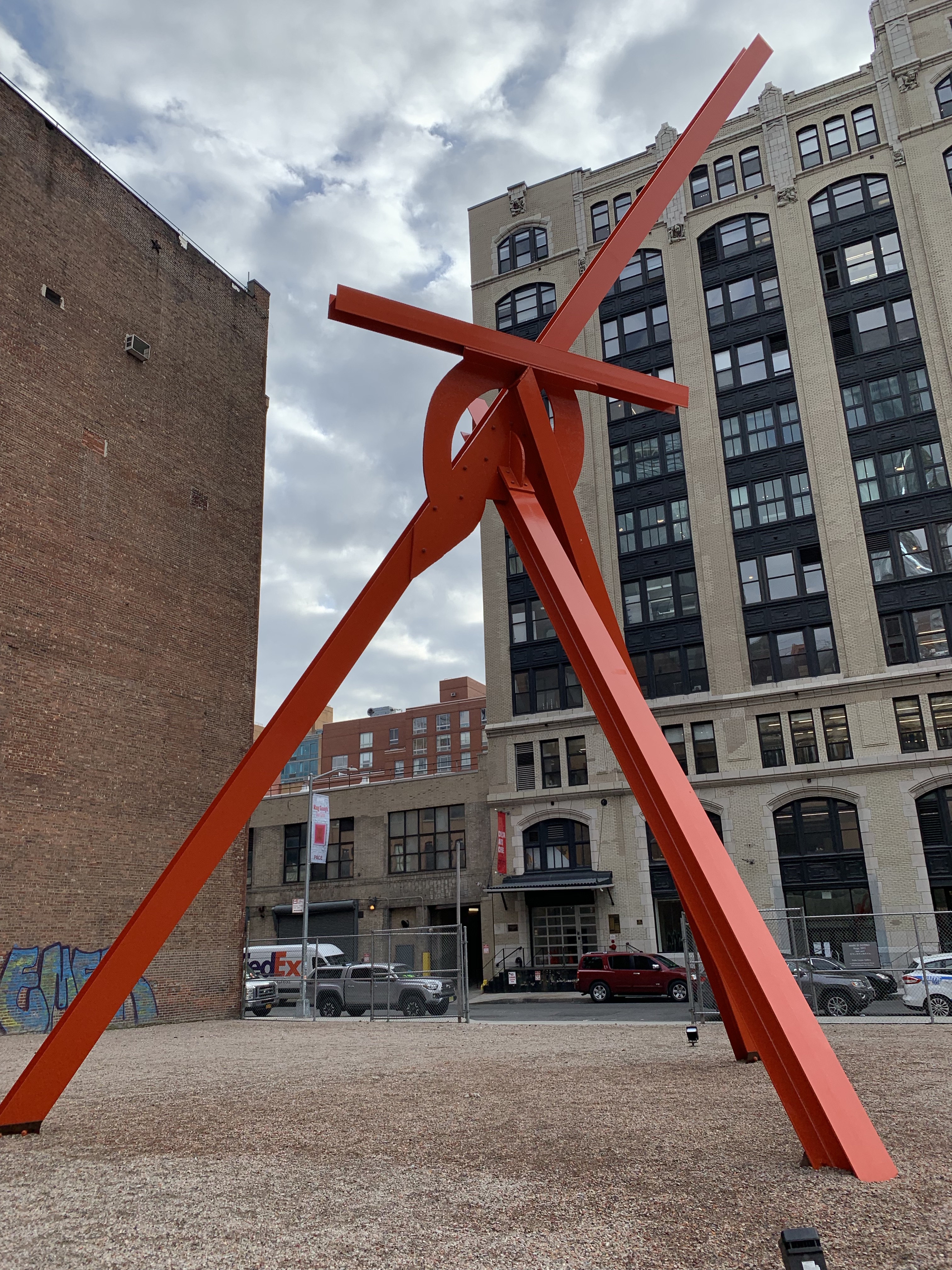
As I was walking home I passed a Mark Di Suvero sculpture called Hugs.

Maybe it is a fitting ending to this first post of the year, sending hugs to all who are reading this.

+WOnxr85Sfu6AxTeTKUeeQ

Dots, Dots and much more….

Once a month I take  a half day to walk two to three streets in Chelsea looking at art.

I compile a list of galleries, search for artists I like and look forward to discover new talent.

In November everyone was talking about the de Vinci, the most expensive art sold at auction to the tune of half a billion dollars. It was time to check what art is being shown at the galleries.

I decided to start my tour with the most talked about art show that opened in town. People are lined up for more then two hours to see  the Yayoi Kusama show at The David Zwirner Gallery.

A few months ago I saw an incredible installation at the Hirshhorn Museum of ten Kusama rooms. It was like diving into the rabbit-hole to Alice in wonderland. Here at the Zwirner gallery there were three rooms which were mirrored installations of balls. When I peeked through a window I could see myself on the other side. The highlight of the show for me was a room of recent works that looks like an a aboriginal work from New Zealand with African-like masks designed by Kusama who  lives and works in Japan. The colorful display makes you feel like you are in a field of flowers. You want to take each painting, transform it into a scarf and wrap yourself in these colors.


At The Jack Shainman gallery, Nina Chanel Abney works  are full of  abstract color but on second look one can discover the story behind the images. She touches on contemporary issues as race, politics, religion and art history. You feel drawn into the images that jump up from the collage-like art.

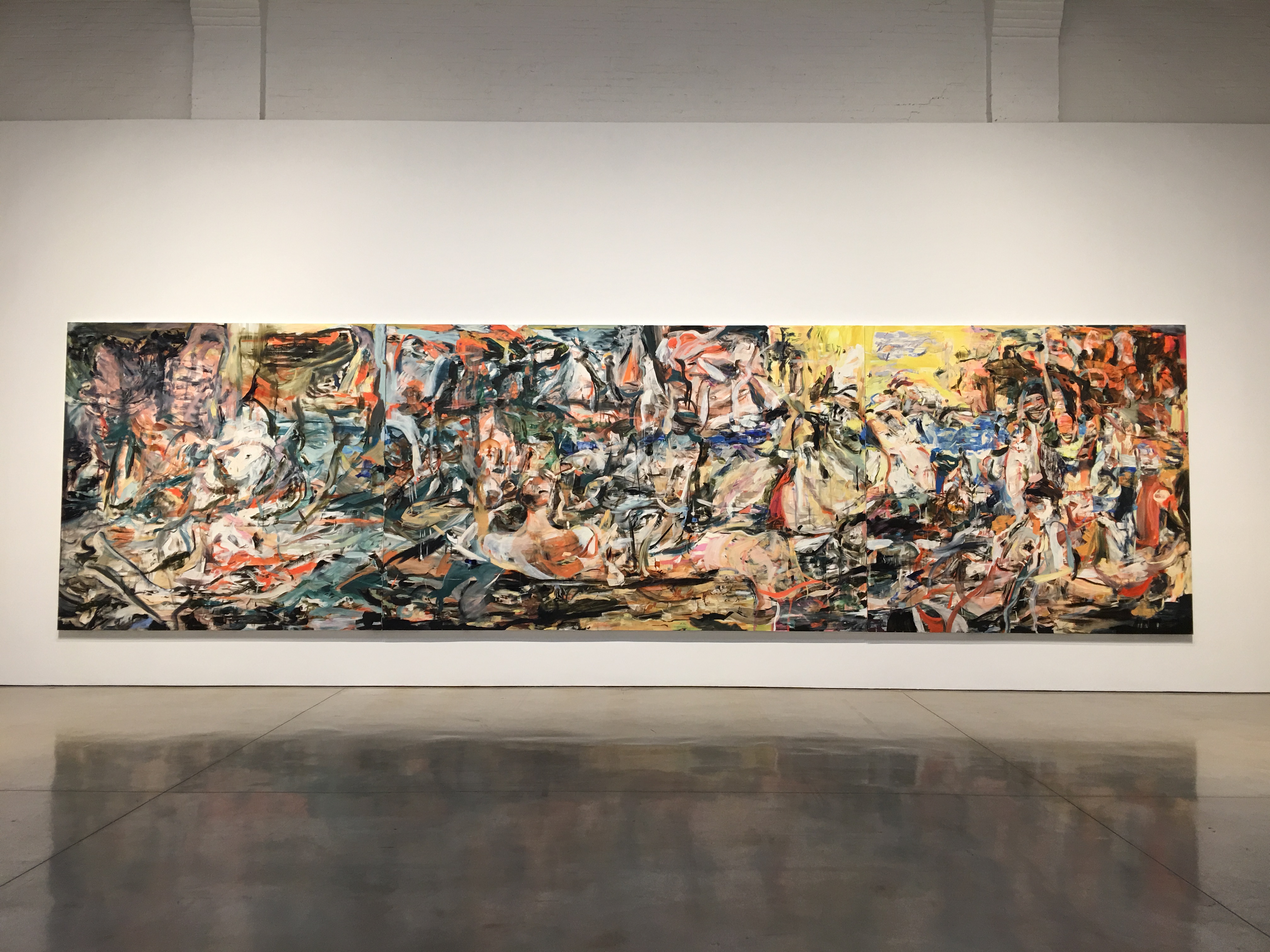
Cecily Brown’s work at Paula Cooper gallery with the title A Day! Help! Help! Another Day! is again full of references to art history’s iconic paintings such as The Raft of the Medusa by Eugene Delacroix and Shipwreck by Theodor Gericault but on closer inspection you can find a burka clad women, which transports us back to the present.

IMG_5765


William Villalongo at The Susan Inglet Gallery was a refreshing exhibit. I had not been previously aware of this artist but his cut-paper work with images of the black male figure lurking from among the cutouts conjures spaces of sensuality, humor and history.

The last two stops were a true surprise. I walked into The Hauser and Wirth Gallery to re-discover the sculpture of David Smith. I have been to Storm King and seen the outdoor sculptures but here in the space of the gallery were pairings of Smith paintings (or rather studies) with miniature sculptures. They were so delicate, yet strong . The show is called Origins & Innovations. The art  indeed reflects the subject.


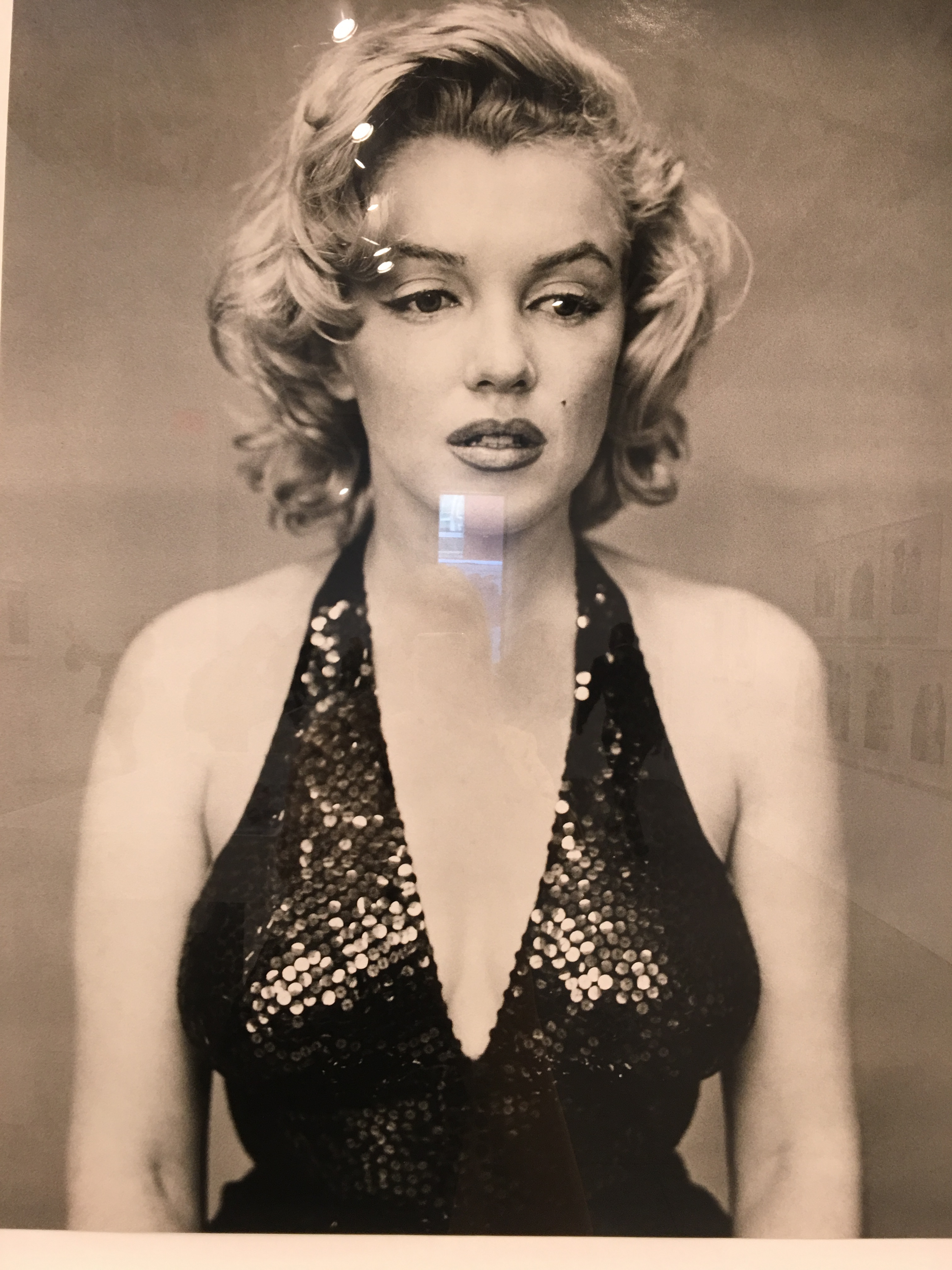
Last stop was Richard Avedon Nothing Personal show at Pace Gallery which gives us a glimpse into the past. The photographs and archival materials are taken from a collaboration with James Baldwin. The two met in high school and throughout their writings dealt with issues of race, mortality or as Avedon wrote  “the future of humanity”.

I chose to highlight one photo of an iconic person – Marilyn Monroe.  We see her without the glamour we usually associates with her image. It’s like we can read her thoughts.

IMG_5775

There are many more shows to see but for now I will leave it to others to explore.
In today’s complex world the colors in the paintings bring a smile and fills my heart with the hope that although contemporary art represents the state of the world today, which is not always bright, there is a a ray of hope in all those red dots, yellow lines and blue skies.

IMG_5782

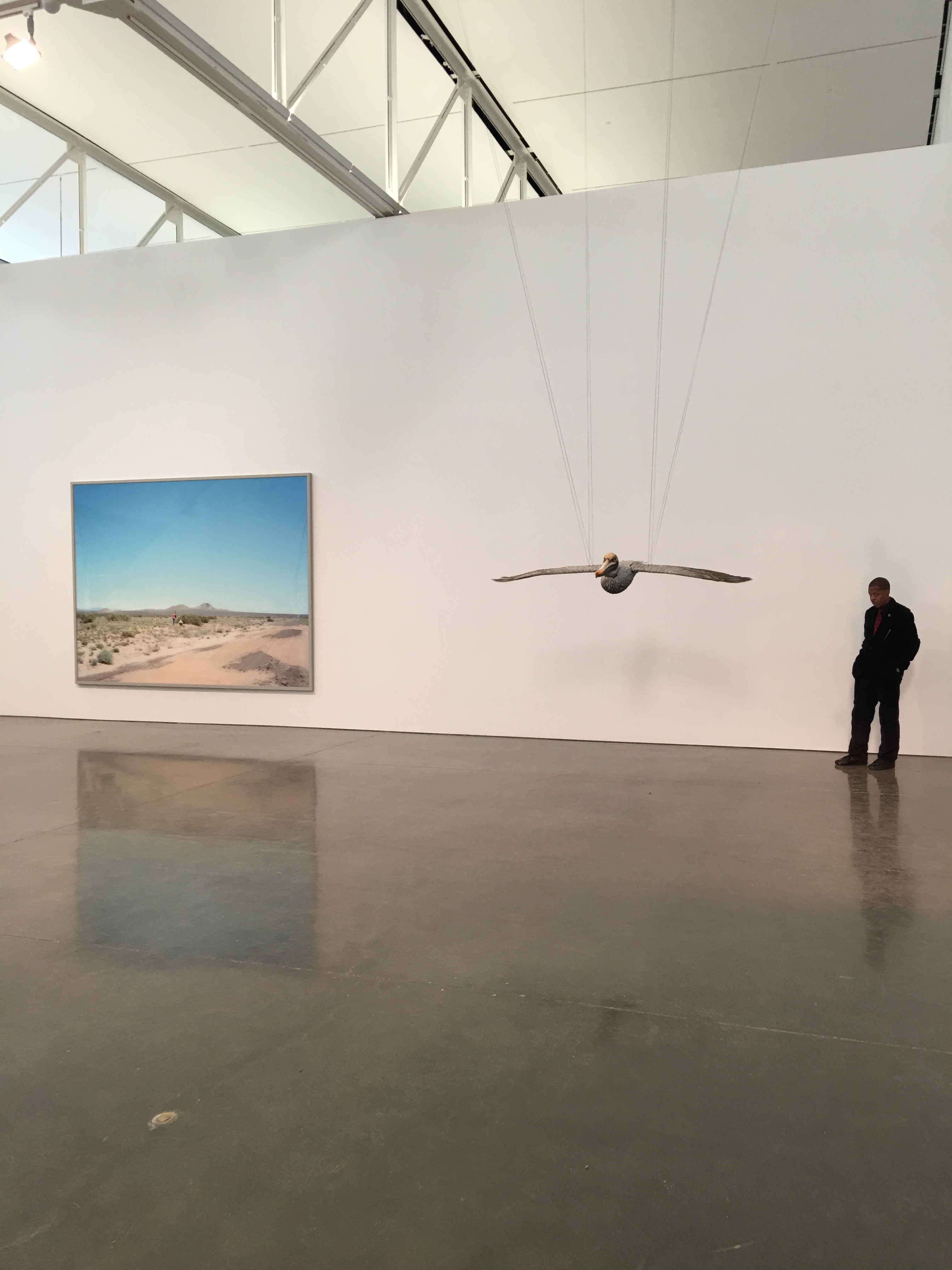
This images was taken at the Gagosian Gallery. Alex Israel Flying Pelican and Jeff Wall California Landscape.

ֵ A journey to the unknown

This week’s parsha is Lech Lecha in which Abraham is called by G-d to leave his country and travel to an unknown land. “To the place where I shall show you”.  These were G-d’s words and G-d promises Abram that he will make of him a great nation and bless him.

I have been traveling in the last few weeks and although I planned to write my impressions earlier, it is today that I find myself ready to share my travel adventures.

When I heard about a JDC (Joint Distribution Committee) mission to Ethiopia my curiosity peaked. The trip was promoted as a journey of an immigrant from his homeland of Ethiopia to Israel.

All I knew was that in the 80’s there was Operation Moses where Jews from Ethiopia who walked to Sudan were airlifted to Israel. In the 90’s there was another operation called Solomon and more came, this time from Addis Ababa.

At that time I was living in the US, busy raising kids and, as an Israeli, acclimating to a new land and culture. I did not follow the plight of the Jews from Ethiopia.

We landed in Addis Ababa, the capital of Ethiopia. It is a busy city with tall buildings, stores and lots of shanty towns. Old Eged buses (from Israel!), blue taxis (from Russia) and bikes are the mode of transportation…  not enough for the millions who live there, so you see many people walking. Kids coming from school in their uniform and women carrying dry wood collected in the forest on their backs. There is a lot of construction and dust. We toured the Ethiopian National Museum and saw “Lucy”.  Lucy consists of several hundred pieces of bone fossils representing 40% of a skeleton of a female of the hominid species and know by its Amharic language as “Dinkinesh” which means “you are marvelous”. We saw the Israeli embassy and met the ambassador; Belaynesh Zenaida, the first Ethiopian-born ambassador. We also met Dr. Rick Hodes who performs medical miracles on children with spinal conditions. He has been working tirelessly since the 1980’s on behalf of those without access to medical care. Although there are no more Jews left, it is important to maintain good relationship between the two governments.

The next day we flew to Axum, a town on the North which was once the crest of the Tigray Jewish community. There is only one paved road; the rest of the roads are unpaved and dusty. There are a few theories as to where the Jews came to Ethiopia from. One theory traces them to Yemen, the other claims that they came down from Egypt but the romantic legend is my favorite. It’s the story of the Queen of Sheba who traveled North to visit King Solomon, fell in love, converted to Judaism and bore a son to him and came back to live in Ethiopia. The story continues that this son went back to visit his father and one of his companions stole the Tablets of the Covenant which are housed in a church in Axum. We visited the church which is built like the Beit Hamikdash (The Temple in Jerusalem). We also saw Helen Sheba palace. We arrived to Axum on Friday and spend Shabbat touring the market which reminded me of the days of Abraham. People sitting on the ground with their merchandise. The Ethiopians are known for their coffee.  They meet three times a day for a coffee break and there is a whole ceremony built around this daily ritual.

We made havdala on top of a mountain overlooking the field of Teff (an Ethiopian grain that is also used to make Ingera; a special spongybread that’s used to eat the different foods and sometimes is used as utensils… yes, no need for fork and knife).

On Sunday we visited a school funded by the JDC. Some of the students walk a few miles by foot to get to the school.

There are no Jews living in the area. The “Beta Israel”; the Ethiopian Jews lived in villages and had their own schools and synagogue. They were called “Falashas” (the landless). The government owned the land and the Jews were mostly metal smiths and worked the land. Amram, who came with us, left his village when he was 5 years old and walked to Sudan with his family in the hope of reaching Jerusalem. “Jerusalem” was a magical word that described the longing for a better place. When reading the Haggadah on Passover we say “Next Year in Jerusalem”. Amram and his generation took it literally…. We walked up the mountain to reach his village; his former neighbors have taken over the abandoned homes. His village was near Mt. Sigd. Sigd is a Jewish holiday celebrated 50 days after Yom Kippur only by Ethiopian Jews.

There was no running water or electricity in the village but the landscape is beautiful. I could imagine groups of people carrying their few belongings, walking through the fields and desert with a longing for Zion. We were following their footsteps, but before embarking on the plane to Tel Aviv we stopped at Lalibella.

Lalibela is called the New Jerusalem although there are no synagogues or strong Jewish history there, rather there are incredible churches carved into the ground. The air is crisp but the roads are unpaved. The homes are build from metal scrapes and wood. On an early morning walk you can see everyone waking up and washing their faces from water in plastic bottles.

I have read about third world countries; here I could see it with my own eyes.

We flew to Tel Aviv, landed in the middle of the night. We were told that when the Ethiopians arrived they did not know what Jerusalem looked like as it was only an idea and they thought that the lights at Ben Gurion Airport was Jerusalem… They were taken to Ofakim, a town in the Negev. I can only imagine their surprise on seeing running water from a faucet or flipping a switch to get light.

Thirty years passed and unfortunately the Ethiopian Jews are not fully accepted by the Israeli society. In the news you read about the injustice done to a soldier or the mistreating of a woman looking for a job just because her skin color is black.

We visited a few programs that deal with empowering the elderly through gardening and a  multi year holistic intervention for Ethiopian-Israeli school children. We visited an Ethiopian culture center in Kiryat Gat where many of them settled.

We learned that even a generation after the community immigrated to Israel, young adults share the same obstacles when looking for a job. At Ort school in Ramat Gan we talked to students at a special 18 month pilot program which is a collaboration with El Al to teach them to be airplane technicians with the promise of a job at the company upon graduation. We also met a young Ethiopian who in 2007 started a not-for-profit called “Olim Beyahad” (rising up together) aimed at helping Ethiopian Israelis who hold university degrees integrate into the forefront of the Israeli workforce.

Our guide, Gideon named the mission: “It takes a village”. At the end of the 10 days  we understood what he meant. Each individual  that embarked on the journey across the deserts of Sudan or to addis Ababa with the dream of Jerusalem had no clue what was there behind the rainbow. They came from small villages carrying their tradition and culture in their mind. It takes more then a village to welcome the newcomers into the family of Israel. There is a comedy skit by Arik Einstein called Aliya in which he portrays hows each wave of immigrants mocks the next wave of new comers but at the end we are all Jews and Israel is our homeland.


Collecting – Life Moments

A little girl, red basket in her hand, walks along the beach. Every other step, she bends down and picks up a shell. When the basket is full she dumps its contents with her mother; who sits nearby, and she continues. The sun is going down, its time to go home. When she gets home she will line all the shells on a special shelf. She likes to collect. She has 30 Barbie dolls, all types; they are from different nationalities and life-styles: “exercise Barbie”, “fashion Barbie,” “stewardess Barbie” and more. Each Barbie gets a shell as a present.

As kids we collect toys. I remember my son’s obsession with having all the different Power Rangers and then all the Ninja Turtles. It seems that with each year there was a new interest. It’s hard to let go, so the comic books, the Transformers, the baseball cards and the key chains all found their place in the basement. All of these are mementos of childhood. Each generation has it’s own collective interest.

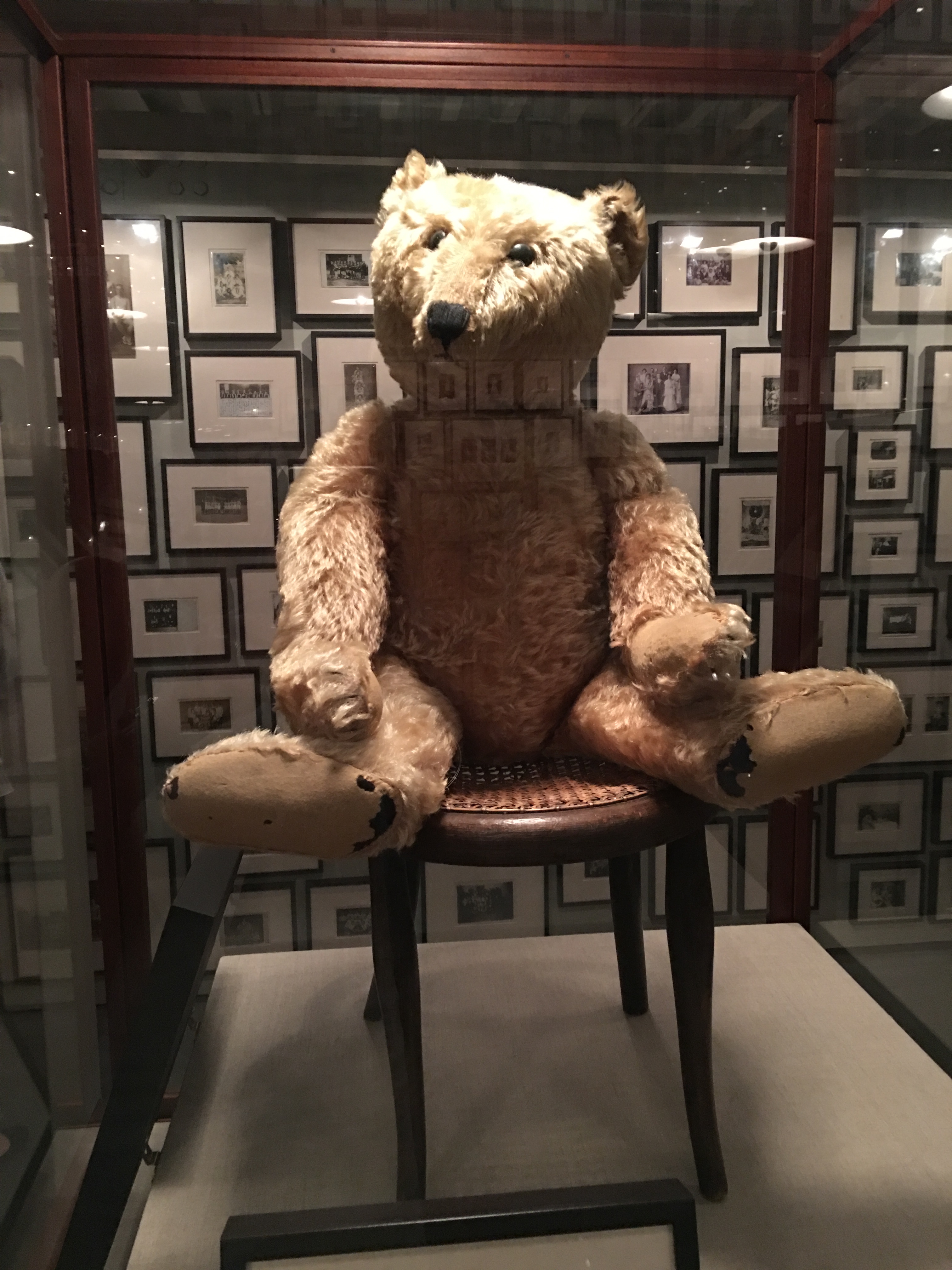
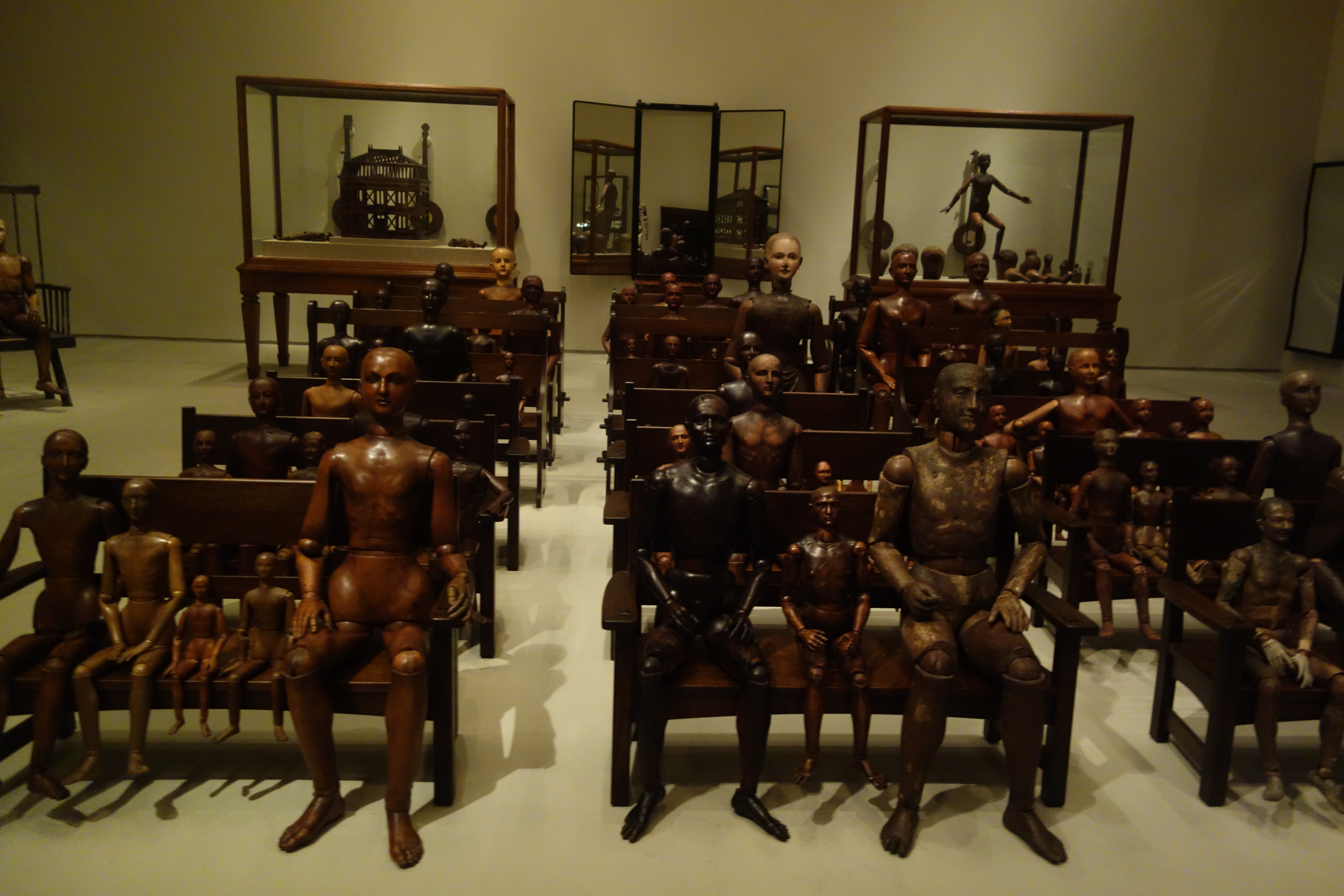
There is an interesting show at the New Museum called The keeper. The exhibit is dedicated to the act of preserving objects, artworks, and images, but what makes it most interesting is the passion for accumulating Teddy Bear images by artist Ydessa Hendeles. I have seen another show of her work at the Helena Rubinstein Museum in Israel where she collected wooden dolls from the past century.

img_9372dsc05973img_9382

Her installation takes most part of the second floor but other artists tell their story through the display of model houses or, for example, a drawing describing the horrors of the holocaust or painting by Hilma of Klint found after her death.

At ICP here

The exhibit is called “Public, Private, Secret” and is about people telling their story. There is a dialogue between and about the diversity of photographic and visual culture in a wholly unique and unexpected way. Each of the artists presented,tells their own story and by that telling we are experience and are drawn to be part of that story.

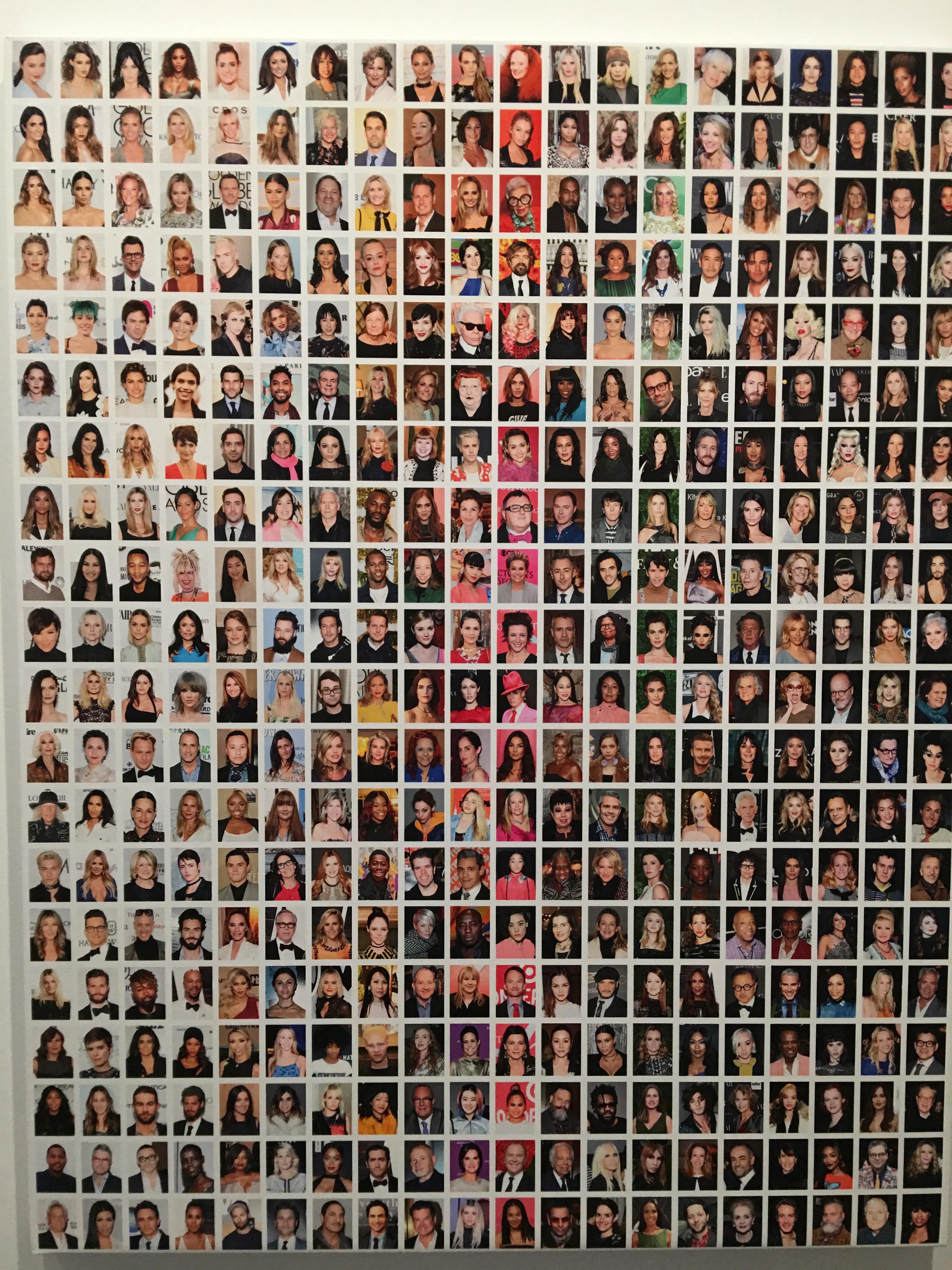
One photograph is a compilation of photos of people at a fashion show. We see their expressions and imagine what they see, what they think.

img_9358

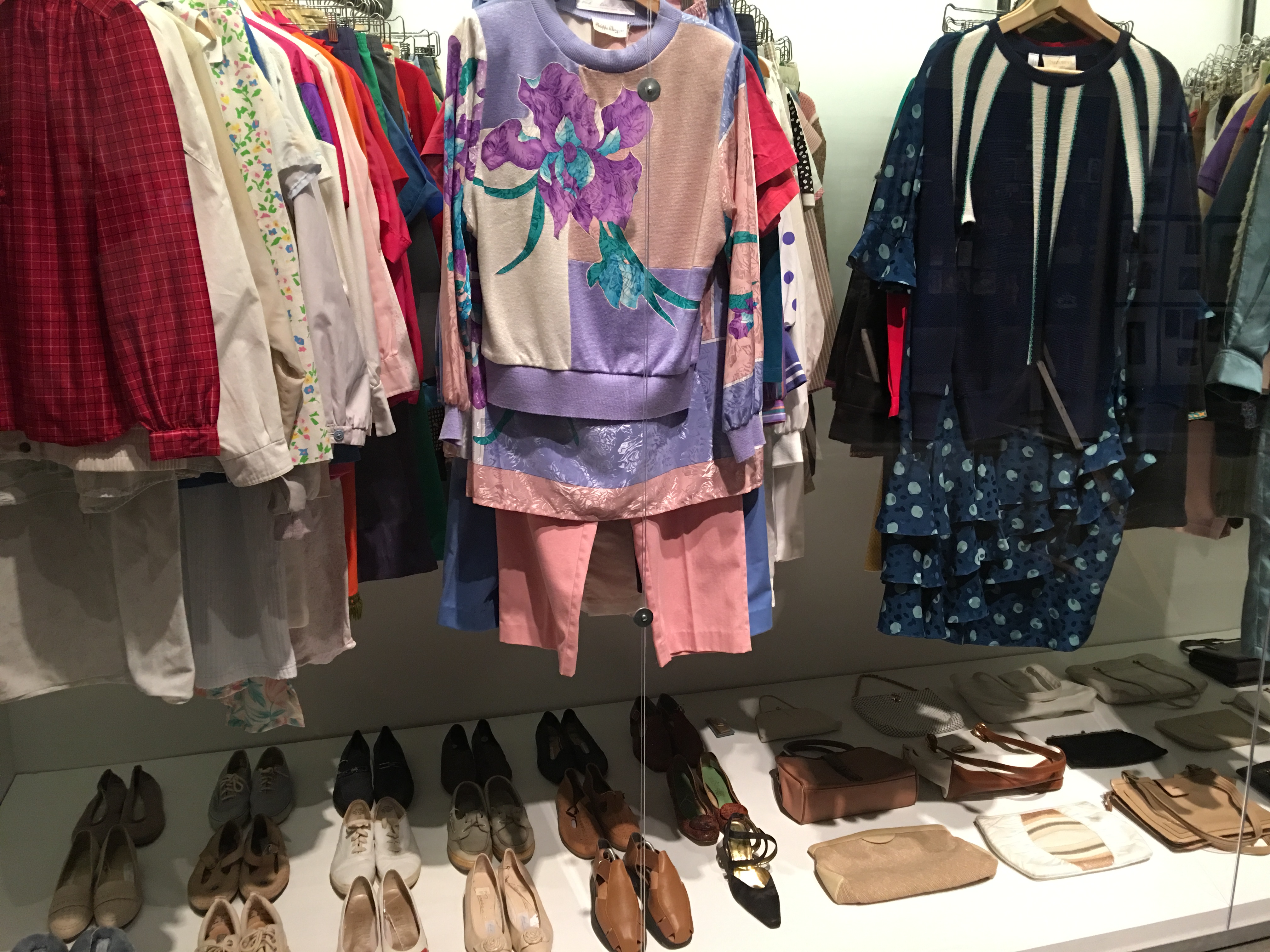
Collecting is not only about art. We all love shopping for cloths and by this act we do collect. The idea of letting go of a favorite sweater or jacket is hard so we are left with a collection of “favorite cloths” that don’t always fit or may be out of the current fashion.

When my family moved to Westport from the city, the movers complained about the number of book boxes we had. We built a library on the second floor; needless to say it was not enough. We tried to categories the books according to our interests, religion, math, art, travel and more. My collection of cookbooks found it’s place in the kitchen and again some books were delegated to the basement.

Life would not be interesting without friends. It could be someone we met on a flight that becomes a friend or someone we see at the gym. Over the years we keep collecting friends. The friendships are the ties that help us go through life. We share happy and sad moments.

What I find fascinating is that as we age, our collective memories make up the building blocks that helps with the challenges of what we call The Third Age. Each experience enriches us. Our mind is like a computer that’s filled with data.

I spend the last week in Israel visiting my Mom. The Biennale of Israeli Ceramics at the Erez Israel Museum is an exhibit not to be missed.

There is also an interesting Picasso show at the Israel Museum. It’s called Drawing Inspiration. What strikes me is that at the age of 86 Picasso painted 365, which is an artistic autobiography, and one can look at as a collection of life-moments.

I started asking my mom to tell me about her life in Tel Aviv. To which school did she go? Who were her friends? Where was she when Ben Gurion declared the birth of Israel? I want to collect these memories, these are her personal stories and through them I get a glimpse of her in a different time and place.

I have seen the performances of an artistic group called Public Movement at the Tel Aviv Museum where they reenacted the declaration of the state and then took a group of ten people through the museum, behind the scenes and through the exhibits. There is a show at the Guggenheim museum called But a storm in Blowing from Paradise: contemporary Art from the Middle East and North Africa. The show presents works by artists from different countries including an interesting video by Uri Gersht walking in Eastern Europe and an installation of sand by Attiya. This exhibit also hosts a performance by the Public Movement Group. I signed up for a one-on-one briefing about art in Palestine before 1948. I did not know but according to their research there is a void and although art was created at that time there is hardly any art to be found by Palestinian artists at any museum in Israel or the West Bank. When I arrived at the museum, it was in the middle of installing a new show. I was met by an agent and was lead through back doors to a room on the 7th floor by the agent who proceeded to tell me the story of the lost art. Here again I found a collection of memories.

In the age of technology when we hardly stop to smell the roses or send a hand written note or read a book in real print, Collecting takes on a different meaning.


AGE-ING: Is it a numbers game?

It all started with a car. My old SUV died and I chose a sport two door roadster. I don’t remember the last time I felt so selfish in choosing something that is going to be hard to share with my grown kids.

A smile was on my friend’s face when he saw the car and asked: does someone have a midlife crisis? I just smiled back. I was puzzled and reflected…. really?? But I turned 60 last year. We all know that 50 is midlife, I am well past it.

The definition for AGE is: “a period of human life, measured by years from birth, usually marked by a certain stage or degree of mental or physical development and involving legal responsibility and capacity” and if we use it as verb to age means to grow old as “she is aging rapidly” (I hope not) or “the wine ages slowly” or “fear aged him overnight”.(The last definitions touches on age as number.)

When we approach 60 we are treated as OLD. Is it Ageism? Ageism is defined as a discrimination against persons of a certain age group or tendency to regard older person as debilitated, unworthy of attention, or unsuitable for employment.

I love numbers and I always try to find hidden meanings. In my twenties I went to University, married and had kids. In my thirties I raised a family. Family raising lasted till almost 50. I saw my job as wife/mother/organizer/volunteer/interior designer/chef/cook/party-planner /artist/collector. None of these were paid in the monetary sense but were appreciated by my family and friends who participated or enjoyed the results of all these interests. In the world we live in there is not much appreciation for us/ women who devote half of their life to the family. The problem arose when my kids grew and started their own life. What am I going to do next? Shall I get a job? Do I want to get involved with volunteer projects? Shall I go back to school? A lot of exciting options but I am still faced with a society who looks at my grey hair and sees OLD.

Just writing this word makes my skin crawl. We need to find a new definition for those of us between 60-70+. We are at the “next prime” as a friend said. We need to find a word that will encompass positivity. A word that a 30 or 40 year old will say: “Whoa this 60 year old is incredible!”.

We need to ask ourselves: how old do we feel? Do we care about our chronological age? If the people around me consider me “old” what does it mean?

I invite your comments. Let me know your thoughts. It doesn’t matter how old you are, what matters is the attitude. Our population is growing and we are living longer. A Rocking chair is not the only way to express our vitality.

Tel Aviv-learn by night

I started thinking about this post almost two weeks ago so although Shavuot is over, it is still on my mind.

It’s Erev Shavuot. On this night it is the custom to study till daylight. Some say it is a cabalistic tradition, maybe that’s the source for the reason we dress in white or it could be,to symbolize purity in preparation of getting the Torah.

I have an image in my head of kids at a kibbutz seated on a wagon singing about the new harvest. In Hebrew it’s called Bikurim which has the same root as the word for morning, “Boker”. I wonder if studying all night till sunrise is also connected to the custom on learning all night.

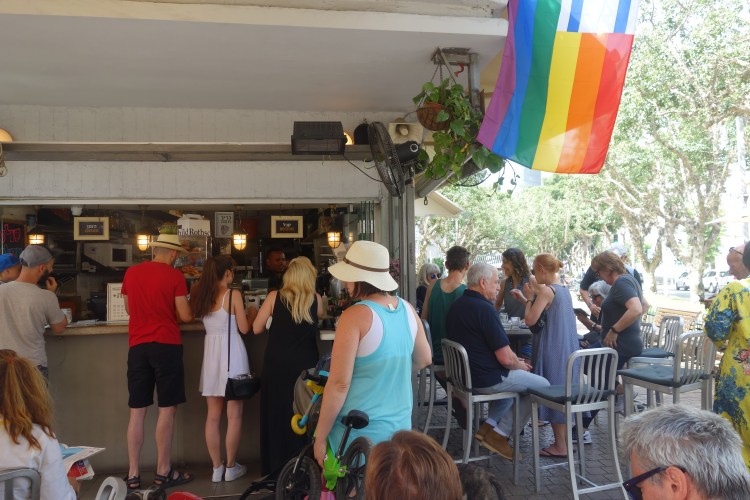
I am in Tel Aviv. It is Saturday; Shavuot starts tonight. When I grew up there was not much to do during Shabbat. Stores and restaurants were closed, but over the last 35 years things have changed. Movie theaters, restaurants, galleries are now open. But with all these changes there is  still a feeling of Shabbat as no one goes to work and the streets are less busy with traffic. The beaches are filled with families and the promenade looks like a track field full of walkers and bikers .You can also spot a chasid going to shul.

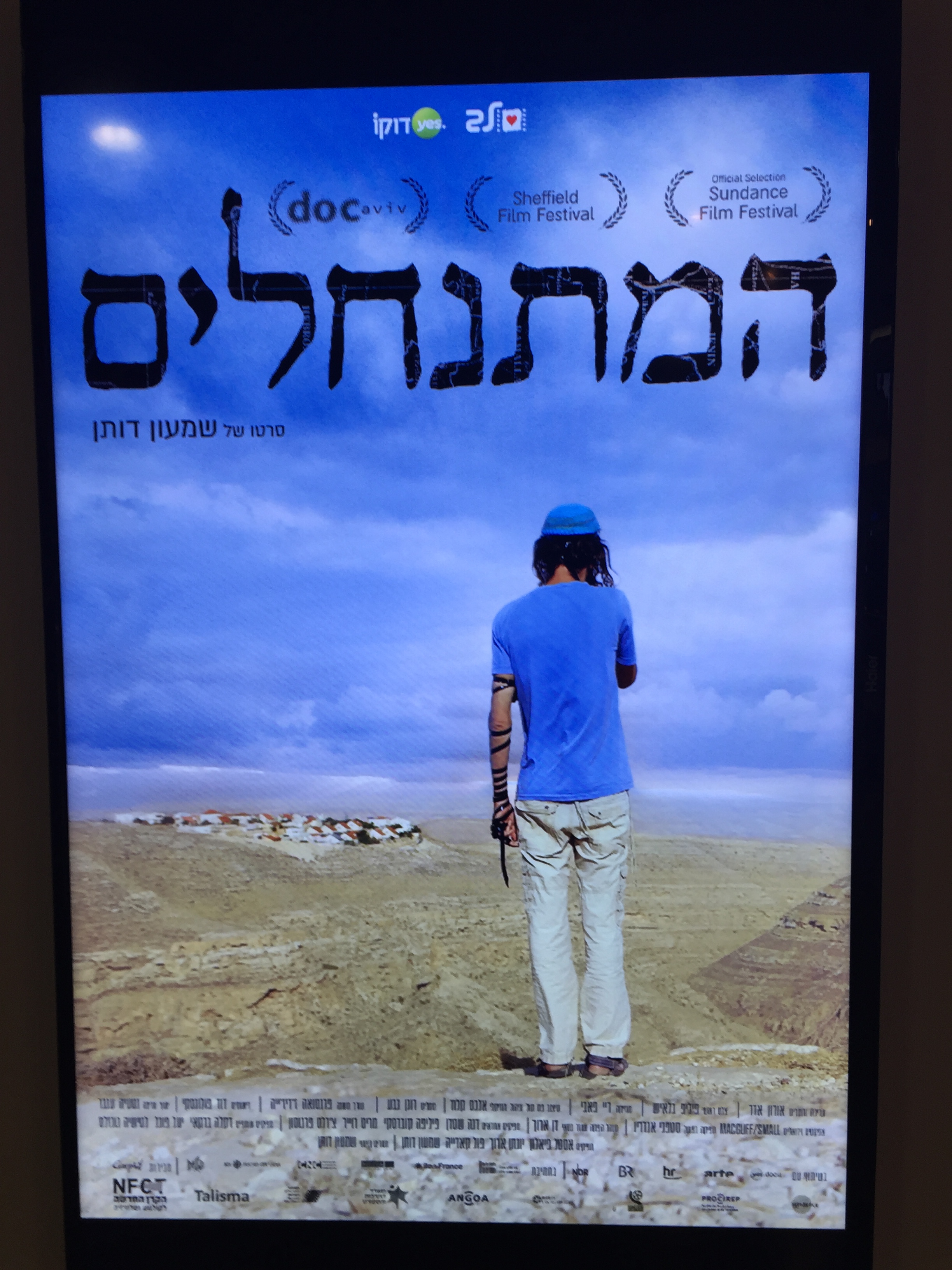
I met friends for lunch  and we chose to see a movie that came out  about the Settler Movement. I was astonished to discover how this movement, which started with a small group of thirty people, grew over the next 40 years to a staggering number of 400,000.  The Settler Movement which is a critical and important issue to the well being of the State of Israel began, we learn, with a forced agreement by a small group of religious people who chose to make a point and live in the West Bank right after it was occupied by the Israeli army in 1967.

This Agreement was signed by Shimon Peres of the Labor Movement. When Menahem Begin became prime minister in 1977, he issued, with the help of Arik Sharon, massive building approvalIMG_1117s to continue and develop the area.  It is an ideological movement but many who live in the West Bank do so for financial reasons. I have not  lived in Israel during this period so it was informative to me  and answered some questions and filled the gaps on some facts. I am not sure a solution can be found. It will have to be a compromise. There are 400,000 people living over the “Green Line” and I cannot imagine asking them to move to other parts of Israel, whether it be the North or South. I believe that we have to start by building trust between the Jews and Arabs who live side by side and enjoy the same sunrise and sunsets.

http://www.haaretz.com/jewish/features/1.700387  (an interview with the film director)

http://www.ijs.org.au/The-Settler-Movement/default.aspx

As the sun went down, we sat to eat the Shavuot meal of blintzes and cheese cake.

The Tel Aviv Municipality sponsored many “tikunim” or studies for the evening of Shavuot. I chose the one at the pluralistic congregation of Beit Daniel. The subject was: “What tomorrow will bring?”. It was 10 pm when I walked into the crowded sanctuary of the synagogue. I heard the author Yair Sachar talk about his book “The Third” about the building and destruction of the Third Temple. An imaginary tale of a contemporary building and destruction of the Temple using the belief in the return of the monarchy as a metaphor for a uprising by an army elitist commander unit. Well, I can not say it was a promising future but everyone is entitled to his opinion. The next lecture was by the author Yochi Brandes who talked about Rabbi Akiva.

She talked about her most recent novel, “Akiva’s Orchard,” Yochi Brandes spins a brilliant chapter out of the incident in Beni Brak, familiar from the Passover Haggadah, when five rabbis study ToIMG_1128rah all night until their students announce it’s time for the morning prayers. In Brandes’ take, the night is not about interpretative one-upsmanship, but rather is the very moment the bery format and content of the Peach Seder was determined. Shavuot is 49 days after we read the Haggadah. She raised the question of how Rabbi Akiva could emerge out of the Pardes (orchard) unharmed yet was part of the horrific decision of the Bar Kochba revolt. Yochi who comes from an orthodox upbringing has a gift of retailing biblical stories or creating bibliographies around the figures in Jewish history. It was a fascinating lecture and I am sure to read her books


It is now after midnight. The synagogue is still full; some are singing in the yard, some take a cup of tea or coffee. The night is not over. They are planning to stay until sunrise. I am going home to sleep.

Some say Tel Aviv is unlike any other place. Tonight I could see a glimpse of a future that can bring peace. Looking at the Torah from a cultural and not only religious perspective can unite us all.

I am back home. In today’s times there is an article about the denial of the” Rabanut” (the high rabbinical authority in Israel) to approve an orthodox conversion by an American rabbi. I ask myself is this where we are heading? Let us learn from Rabbi Akiva’s mistake and learn to sit together in harmony.